How to Celebrate Work Anniversaries: 24 Ideas From a CEO Who Did It at Scale
By Scott Wolfe | Updated April 2026
“Transitions should be marked and milestones commemorated,” write Chip and Dan Heath in Power of Moments — a book I think every People Ops leader and CEO should own. They’re right. Work anniversaries are some of the most reliably recurring transitions in any company’s calendar. The question isn’t whether to mark them. It’s whether you do it in a way that means something.
When I was leading Levelset toward what became a ~$500M acquisition by Procore, the moments I worried about most weren’t the big milestones. They were the quiet ones. The ones that happened on a Tuesday, without fanfare, when someone hit their one-year or three-year mark and we either made them feel seen or we didn’t.
Levelset grew to 400+ people. At that size, work anniversaries don’t just happen on their own. You build systems for them, or they disappear. We tried both. The first approach — letting them happen organically — quietly damaged culture in ways that took months to diagnose. The second — treating anniversaries as deliberate, recurring moments — helped us keep people and build the kind of loyalty that doesn’t show up on a dashboard until it’s gone.
Here’s what I learned, plus 24 specific ideas across budget levels and team sizes.
Why Work Anniversaries Matter More Than You Think
The work anniversary is quiet by nature. Unlike a product launch or an all-hands, it doesn’t announce itself. But your team member notices it. On the day they hit one year — or five, or ten — they’re asking themselves a set of questions whether you acknowledge it or not:
- Do I still like it here?
- Have I grown?
- Am I actually appreciated?
- Is this still what I thought it would be?
Sometimes shortened to “workiversary” or “workaversary,” it’s simply the anniversary of a team member’s start date. It’s a milestone. And the research backs up what I felt intuitively. Employees who feel recognized are 4.6x more likely to do their best work (Gallup). Organizations with high recognition cultures see 31% lower voluntary turnover than those without (O.C. Tanner, 2024). Adopting a simple recognition program that acknowledges work anniversaries can increase average employee tenure by 2 years (Select Software Reviews).
Miss the moment, and you’ve let a signal pass. Let it pass often enough, and you’ve got an employee retention problem that shows up in your numbers six months later — long after the moment you could have changed it.
Think about crossing the 1-year anniversary mark in an important romantic relationship, and now imagine your partner didn’t take account of it at all. You’d feel pretty jaded, wouldn’t you? Work relationships aren’t that different. People put a lot of commitment and dedication into a work environment. It’s a big decision to start a job and to stay at a job. And there are real compliance considerations around birthday celebrations and anniversaries that HR teams should understand before building out their recognition programs.
The Work Anniversary vs. the Birthday: Why the Anniversary Is Actually More Important
Birthdays happen to everyone. Work anniversaries happen because of a choice — the choice to stay. That distinction matters.
Your team member’s birthday is personal. Their anniversary is organizational. It’s the day they chose to keep showing up, and it’s the day you have the clearest possible opportunity to tell them that you noticed and that it means something.
A birthday you forget is awkward. An anniversary you forget is a signal. It says: you could leave, and we wouldn’t have noticed.
Don’t send that signal.
The Power of Moments: Why Anniversaries Are a Bulls-Eye Opportunity
In The Power of Moments, the Heath Brothers dig into research showing that certain brief experiences have outsized impact that jolt, elevate, and change us. Work anniversaries are a bulls-eye “moment type” that demands close attention from leaders and organizations.
Their research found that moments are created from one or more of four elements:
- Elevation: Experiences that rise above the routine
- Insight: Moments that deliver realizations and transformations
- Pride: Commemorating people’s achievement
- Connection: Experiences that bond us together
Work anniversaries touch on every element. To get this important celebration right, think about creating a moment that incorporates all four.
For example: elevation means going beyond the routine card and cake — a surprise lunch, a personalized video from teammates, a thoughtful gift. Insight means leaning into the reflection the employee is already doing — a photo slideshow from their time, a “yearbook” with messages from the team. Pride means making their contributions visible to others. Connection means strengthening the bonds between teammates and managers.
Five Work Anniversary Mistakes That Actually Damage Culture
I’ve made most of these. Learn from the pattern.
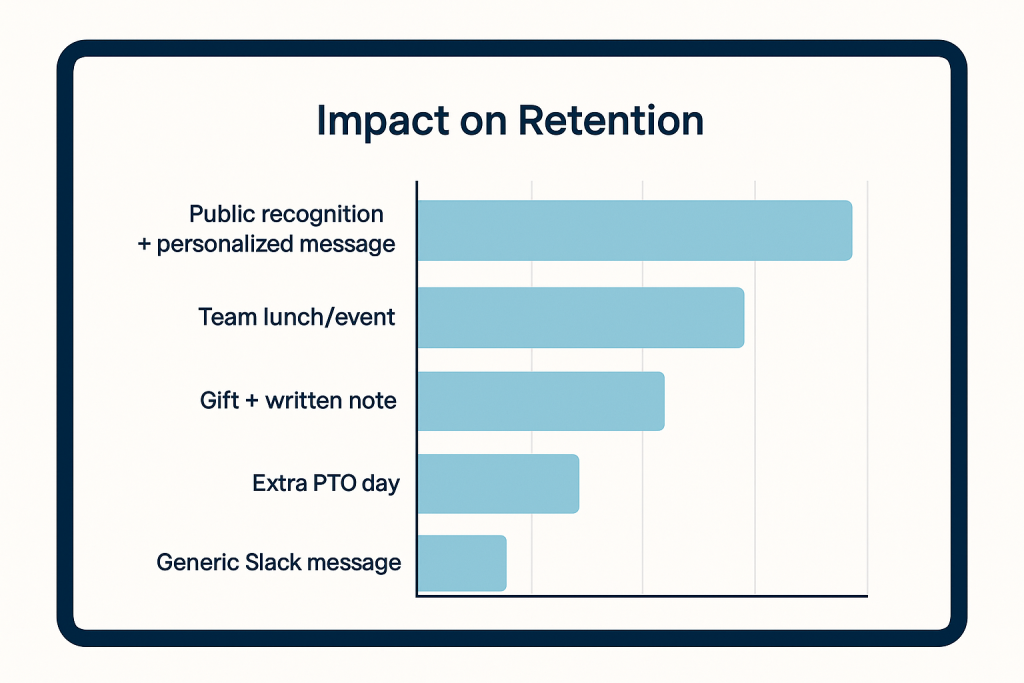
1. The generic Slack message. “Happy Work Anniversary! 🎉” sent to a Slack channel at 9am from an automated bot, with no personalization. This is the minimum viable effort, and it reads exactly like that. Worse, it signals that you automated this, which signals that you didn’t think about it.
2. The surprise nothing. Team member hits their 5-year mark. Nobody says anything. They notice. They don’t say anything either. They update their LinkedIn profile and start taking recruiter calls.
3. The retroactive acknowledgment. “Oh, I see it was your anniversary last week, happy anniversary!” This is somehow worse than forgetting. It confirms you knew and still didn’t prioritize it.
4. The one-size-fits-all treatment. Year 1 gets the same response as Year 10. A milestone year for a key contributor deserves a different level of acknowledgment than a first anniversary for someone still finding their footing. Differentiation is appropriate.
5. The off-platform celebration. You send a gift card via email. The team never sees it. The public signal never happens. The employee gets a Starbucks card and wonders if anyone else noticed. Public visibility isn’t performative — it’s part of the signal.
What “Meaningful” Actually Looks Like
Here’s a test. After the anniversary acknowledgment, can the team member answer yes to these three questions?
- Did someone take the time to say something specific about me and my contributions?
- Did my team or my manager make this feel like a real moment, not a checkbox?
- Do I feel more certain that I’m valued here today than I did yesterday?
If the answer is yes to all three, you did it right. If any of them is no, you left value on the table.
Specificity is the difference between “Happy Anniversary” and something that person will remember for years. I’ve had Levelset employees tell me years later about a specific work anniversary message I wrote them. Not because it was elaborate — because it named something true about their contribution. That’s it. That’s the whole thing.
The 9 Ways I Created Work Anniversary Moments as CEO
Work anniversaries were extremely important to me as CEO of Levelset. At 450+ people at scale, we had one or more occurring nearly every day. I always understood the value of this moment.
In fact, I genuinely considered it my moment as the leader, because it was a time for me to reflect on and appreciate one of our team members, many of whom I worked closely with or saw their contributions first-hand. When someone hit a 5-year or 10-year milestone, it was enough to create rocks in my stomach, because of how grateful I was for all of that belief in me as a leader and commitment to our efforts. That is why work anniversaries matter and should be elevated.
Here’s what that actually looked like, as CEO working closely with our People Ops team:
1. I made it personal. A generic “Happy Anniversary!” Slack message is worse than nothing. It signals you noticed the date, not the person. I wrote or recorded something specific: what they’d worked on, what I’d watched them grow into, what the team would look like without them. That specificity is the signal.
2. I went public with it. Private acknowledgment matters. Public acknowledgment matters more. I’d call out milestone anniversaries in all-hands meetings, in our main Slack channel, in front of the whole company. We’d also post a “happy work anniversary” message to the full team in our #general channel for everyone to see and react to. When the team was small, we’d post individually on the date. As the team grew, we’d post a weekly or monthly group collage of photos. Visibility is a form of respect.
3. I used the manager. Once we hit 100+ people, I couldn’t be everywhere. So I built the habit into our manager layer — and I checked in to confirm it was actually happening. My example cascaded down through the organization, so that other leaders, managers, and teammates were sending personal messages at this milestone as well.
4. I matched the scale of the celebration to the scale of the milestone. Year one is different from year five. Year ten is different from both. Don’t treat every anniversary the same. The size of the acknowledgment should match the size of the commitment.
5. I gave time, not just things. Gifts are fine. An extra PTO day, a long lunch, a “do whatever you want this afternoon” — these cost something real, and they signal real appreciation. The point wasn’t the gift. It was the signal behind it.
6. I asked the team to contribute. For longer-tenured people, I’d prompt the team to share a memory or shoutout in advance. As a work anniversary approached, our People Ops group and managers would circulate virtual anniversary cards or physical cards to people who worked closely with the teammate celebrating. Collected, those become something the person keeps. A Slack thread of 20 messages saying “here’s what you mean to this team” is worth more than any swag box.
7. I tied it to growth. A milestone is a natural opening for a different kind of conversation: “What do you want your next year here to look like?” Milestone celebrations like anniversary reviews — not performance reviews, growth reviews — are one of the most underused retention tools I know. While CEO, I spent a lot of time having 1:1 coffee dates with team members, primarily triggered by two moments: when someone joined, and when someone crossed an anniversary. These were triggers for me to set up an informal session over coffee or Zoom — to catch up, get a better sense of how they saw things, and make sure they knew how grateful I was.
8. I read the room. Some people don’t want public attention. I learned that the hard way. For those people, a heartfelt written note matters more than a team celebration. Know who you’re dealing with.
9. I systemized it. At 400 people, I couldn’t hold everyone’s anniversary in my head. I created Slack and email alerts of upcoming work anniversaries, delivered at the start of each month and week. The system didn’t replace the humanity. It protected it. That’s what CultureBot does today — the automation handles the calendar so the humans can handle the moment.
After Levelset was sold, the acquiring company didn’t do any of these things. Sure, they were bigger. And sure, it wasn’t the end of the world. It’s not essential to the business. But I can tell you for certain that the difference was noticed, and it made a difference.
15 More Ideas: How to Celebrate Work Anniversaries
Here are 15 other strategies and ideas. The remarkable thing about this list is how many work just as well remotely as they do in person. The important thing isn’t where people are located. It’s shining a spotlight on them.
Low-budget / High-meaning:
- Hand-written card from the manager or CEO — rare enough in this era that people actually keep them
- Public Slack shoutout with a team-contributed memory thread
- A short personal video message (60 seconds from the CEO goes a long way at sub-100-person companies)
- “Year in review” — what they shipped, what they built, how they’ve grown. Written by you, not HR.
- Ask five teammates for a memory working with this person, compile it into a note
Mid-budget / Scalable:
- Gift card to their favorite restaurant or experience
- A dedicated anniversary Slack channel for the day (#5-years-[name])
- An extra PTO day — surprise it, don’t just quietly add it to the tracker
- A team lunch or dinner, even virtual, in their honor
- Anniversary kit: something branded + personal note + gift card
High-touch / Long-tenure:
- CEO or exec 1:1 specifically about the anniversary and their next chapter
- A book they’ve mentioned wanting to read, with a personal note about why you thought of them
- A charitable donation in their name to something they care about
- Recognition at the next all-hands with a specific “here’s what you’ve built” story
- A growth conversation: “You’ve been here 5 years. What would make year 6 the best one yet?”
One more worth calling out: exclusive swag for milestone years. At Levelset, everyone got a fleece when they hit their 1-year mark. The team would chant “fleece, fleece, fleece.” People walked around the office wearing them like a badge. They became role models to new hires. That swag became a marker within the company, showing others that people were really bought in. Physical and concrete items are king when it comes to celebrating work anniversaries.
Anniversary Celebration Ideas by Budget
| Type | Effort | Cost | Best For |
|---|---|---|---|
| Slack shoutout + team memory thread | Low | $0 | All team sizes, any milestone |
| Hand-written note (CEO or manager) | Medium | $0 | High-trust teams, any milestone |
| Extra PTO day | Low | Variable | All sizes — strong signal |
| Gift card ($25–100) | Low | $25–100 | Year 1–3 milestones |
| Team lunch or virtual celebration | Medium | $50–200/person | Year 3+ or milestone years |
| CEO 1:1 growth conversation | Medium | $0 | Year 3+ / high performers |
| Experience gift (class, trip, event) | Low | $100–500 | Year 5+ milestones |
| Team-contributed year-in-review video | High | $0–150 | Year 5+ / key contributors |
| Charitable donation in their name | Low | $100–500 | Mission-driven teams |
| All-hands recognition + story | Medium | $0 | Year 5, 10, 15+ |
What’s Actually at Stake
Done right, work anniversary celebrations serve three parties at once. The research on types of recognition consistently shows that peer recognition and public acknowledgment are among the most impactful — and anniversaries are a natural trigger for both.
For the employee: Belonging. A clear signal that their continued presence is noticed and valued. Employees who are recognized at work have a 56% lower likelihood of looking for a new job in the next year (Workhuman).
For the manager: A built-in reason to have a real conversation — not a performance check-in, but a belonging conversation. “Do you like it here? What would make next year better?” Most managers never ask this directly. The anniversary gives them an opening.
For the company: Retention math. The cost of replacing an employee runs from 50% to 200% of their annual salary (SHRM). A genuine anniversary moment that keeps someone engaged costs a fraction of that. Before you set your peer rewards budget, it’s worth understanding just how much unacknowledged milestones cost you in turnover.
The ROI is real. It’s just invisible until the person leaves.
How CultureBot Can Help
At Levelset, I built manual systems to protect these moments as we scaled. CultureBot is what I wish I’d had.
Here’s what it handles automatically:
- Tracks every team member’s start date via Slack or HRIS sync
- Posts anniversary celebrations automatically in your chosen channel with customizable messages
- Prompts the team to contribute shoutouts before the anniversary arrives
- Scales up for milestone years (Year 1, 3, 5, 10) with different celebration formats
- Gives managers an advance heads-up so the personal touch can happen on top of the automated one
The automated part protects the human part. It means the moment never gets missed — not because someone forgot, but because the calendar got away from them.
See how CultureBot handles work anniversaries →
Frequently Asked Questions
Q: How do you find out when someone’s work anniversary is?
Most HRIS systems store hire dates. If you don’t have a formal HRIS, a simple spreadsheet with hire dates sorted by month works fine for teams under 25. Past that, you want automation — either through your HR system’s notification feature or a tool like CultureBot that syncs automatically.
Q: What’s the right work anniversary gift by year?
Year 1: Something personal and low-cost ($25–50). The point is acknowledgment, not the gift. Year 3: A meaningful experience or gift card ($50–100) plus public recognition. Year 5: A substantial gift or experience ($150–500), public all-hands recognition, and a growth conversation. Year 10+: Something the person will remember and tell others about. Make it personal to their interests, not generic company swag.
Q: Should you celebrate every year, or just milestone years?
Every year, at minimum with a personalized message. Milestone years (3, 5, 10) with escalating celebration. Some companies skip Year 1 acknowledgment because it feels too soon. I disagree. Year 1 is when people are deciding whether to stay long-term. That’s exactly when you should be sending the signal.
Q: What if someone is underperforming at their anniversary?
This is the question most managers avoid, and I understand why. The anniversary and the performance conversation are separate signals. Not acknowledging the anniversary because someone is underperforming conflates the two. Their tenure is still real. A private conversation focused on growth may be more appropriate than a public celebration. Read the room.
Q: Can work anniversary celebrations scale to a remote team?
Yes — and they’re arguably more important for remote teams, where organic visibility is harder. A Slack channel shoutout reaches the whole team instantly. A team-contributed memory thread works just as well asynchronously. The form changes; the signal doesn’t.
The Part No Tool Can Automate
Work anniversaries are quietly powerful. They’re predictable, they’re personal, and most companies still manage to miss them — or handle them in a way that does more harm than good.
What I learned over a decade at Levelset: the right answer isn’t complicated. Make it personal. Make it visible. Make it repeatable.
The 24 ideas in this post give you the what. Your job is to bring the sincerity.
That part doesn’t automate.