In my years in HR, I put out a lot of fires. Some stretches felt like a hamster wheel, with a new issue popping up as soon as the last one was handled. During those stretches, I paid close attention to how the leaders around me handled the pressure.
The best ones had a trick. They knew their reaction set the tone. If a leader looked frustrated, everyone walked away thinking the situation was frustrating. So in the middle of the chaos, they controlled the one thing they could, and they went looking for bright spots. They’d point to a win the team could still claim, or an employee who lived out a company value during a hard week.
Watching them, I saw what that habit did for a team. Pointing to what was working, even with problems still on the table, helped people stay calm, stay positive, and keep going when things felt overwhelming. It’s a skill I’ve worked to build ever since.
A culture of recognition spreads that habit beyond your leadership team. When people regularly notice and thank each other for good work, everyone gets better at seeing what’s working, who’s showing up, and how your values play out, even on hard days. Employee profiles keep those moments around long enough to learn from.
A culture of recognition is building the habit of finding bright spots
Chip and Dan Heath have a name for this in their book Switch: the bright spot approach. Instead of obsessing over what’s broken, you ask one question: “What’s working, and how do we do more of it?”
Recognition puts that question into everyday practice. Sending and receiving shoutouts from your peers feels good, and the habit it builds is even more valuable. Every time someone stops to thank a coworker, they practice looking for bright spots, and the more they practice, the easier those moments are to find and repeat.
72%
of employees with great recognition say small wins get noticed, compared with 16% with poor recognition
3.8x
more likely to feel connected to the culture when recognition is part of it
4.9x
more likely to know what’s expected when recognition matches company values
Source: Gallup and Workhuman, Workplace Culture research, a study of U.S. employees.
Teams with great recognition catch the small, everyday wins that would otherwise slip by, and that attention pays off. In the same research, employees who felt strongly connected to their culture were 55% less likely to be looking for a new job.
Good moments fade when no one keeps them
A shoutout in Slack gets a few reactions, and then it scrolls out of view. No one sees that the same teammate has been thanked five times this year for helping new hires. When review season comes, the win from March is long forgotten.
A bright spot you can’t see is hard to learn from. The Heath brothers tell a story in Switch about a company that went looking for its bright spots. When Genentech launched an asthma drug called Xolair, two of its saleswomen were selling about 20 times more than their peers. The company studied what those two were doing differently. It turned out they were teaching doctors how to give the drug, which was a shot many doctors weren’t used to. Once leaders could see what was working, they could help the rest of the team do it too.
Every team has people like those two reps, doing something well that others could learn from. Employee profiles in CultureBot make that easier to see. Shoutouts stay on each person’s profile, so every profile becomes a running record of what’s working on your team.
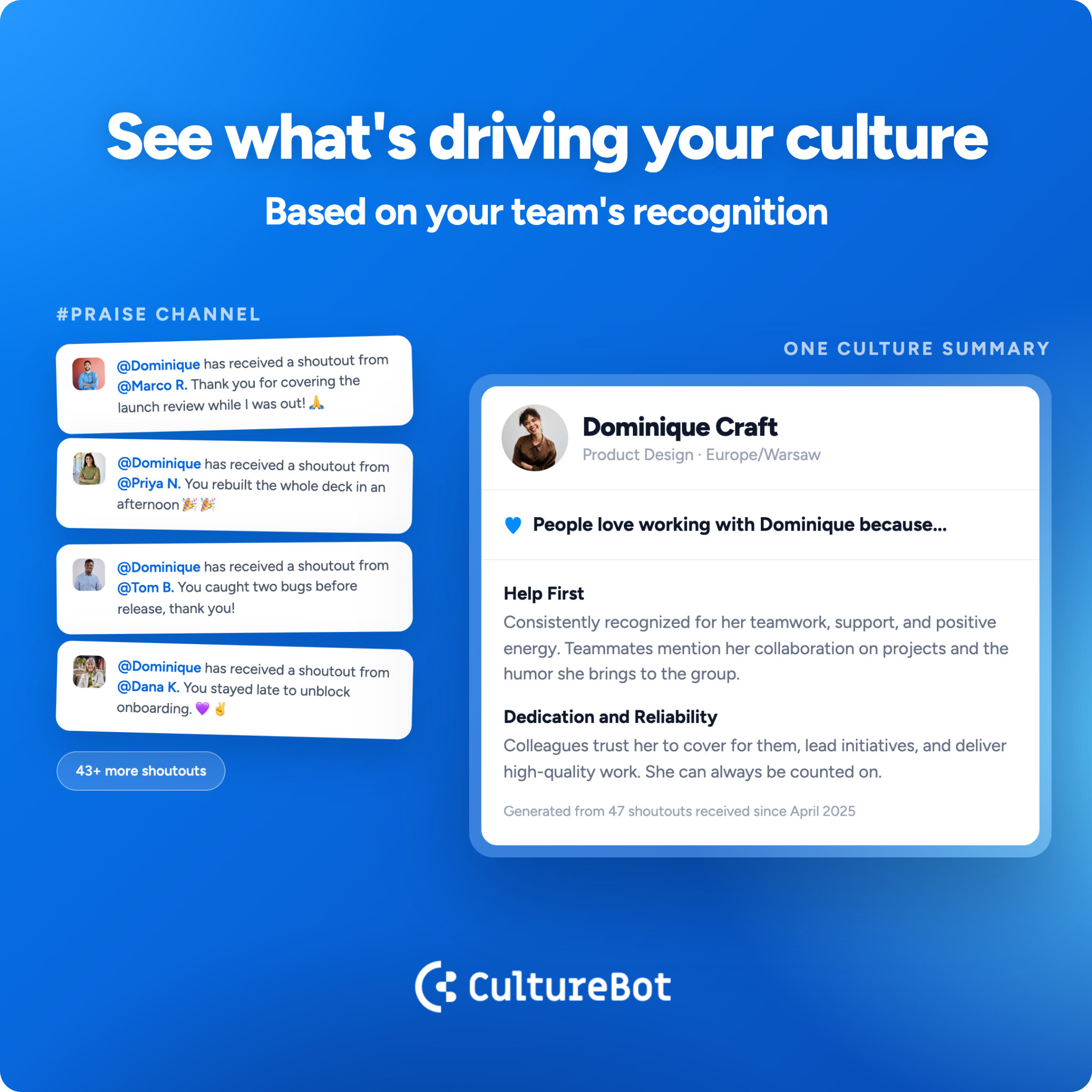
Employee profiles shine a light on the bright spots
Every employee gets a profile, and everyone can browse them in the company Directory. Work details fill in from your HR system, and recognition fills in from the shoutouts your team already sends in Slack or Teams.
1. Recognition that builds over time
Great for: employees, managers, and review season
• Every shoutout a person receives adds to their profile, and feeds their Culture Summary, an AI-written summary that groups their recognition by theme.
• Employees can watch their contributions add up over months, so a thank-you keeps meaning something after the moment passes.
• Before a 1:1 or a review, a manager can open a direct report’s profile and read their Culture Summary to see what peers thanked them for all year. The win from March makes it into the conversation.
2. Your values, in motion
Great for: launching or refreshing your company values
• Name your shoutout types after your values, like “Customer First” or “Own the Outcome.” Each type becomes a badge, and every shoutout counts toward it.
• Picture this in your feed: “Thanks to Priya for fixing the payroll export before Friday’s run. That’s Own the Outcome.” Priya earns a badge, and everyone who reads it learns what the value looks like on a busy Friday.
• Earned badges show in color with a count, and the rest stay grey. At a glance, anyone can see which values a teammate is known for.
3. The people behind the work
Great for: new hires, leaders, and remote teams
• New hires can look up their manager and teammates before they meet, and walk into their first call with something to talk about.
• Leaders feel more approachable when their profile shows the person behind the title, like a favorite band, a hobby, or the languages they speak.
• Skills and interests help people find each other across teams and locations. Pair profiles with Watercooler and Employee Introductions, so people who meet in Slack can look each other up.
• Your Company page keeps your mission, values, and ERGs in one place. Need help writing them down? Our guide, Beyond the Handbook: What to Include in Your Company Culture Guide, includes a free template.
How to build a culture of recognition that lasts
Profiles keep bright spots visible, and these habits help your team keep finding more.
• Launch with a profile week. Ask leaders to fill out their profiles first and share them in a company channel. Then post a fun prompt, like “Add your favorite song to your profile, and we’ll build a team playlist.” CultureBot also sends each employee a welcome message the day after they download the app, asking them to complete their profile.
• Be specific. Encourage people to name what the person did and which value it showed. “Thanks for walking the new hire through payroll setup” sticks with people far longer than “Thanks for your help.”
• Notice the small wins. A quick fix or a patient answer deserves a shoutout as much as a big launch. Small wins are where the habit gets built.
• Open meetings with a bright spot. Read one shoutout from the past week at the start of a team meeting, and name the value it shows.
• Check profiles before 1:1s. Managers who glance at recent recognition walk in ready to talk about what’s working.
• Let people own their story. Only the employee can edit their About Me and personal details, and they choose whether to celebrate their birthday and work anniversary.
Culture of recognition FAQ
What is a culture of recognition?
A culture of recognition is a workplace where people regularly notice and call out good work, from peers as well as managers. The strongest ones tie recognition to company values, so everyday thank-yous show what the company cares about.
Will badges feel like a gimmick?
Badges feel empty when people can earn them by clicking a button. In CultureBot, every badge comes from a shoutout a coworker wrote about something real. The badge is a record of people noticing each other.
Who controls what’s on an employee’s profile?
Admins fill in work details like title, department, and manager through an HR system sync or a spreadsheet import. Only the employee can edit their About Me and personal details.
Do employee profiles work in Microsoft Teams?
Yes. Everyone in your connected Slack or Teams workspace gets a profile automatically.
Getting started
Most of the setup is already done. Everyone in your workspace has a profile from day one. To fill in titles, departments, managers, and start dates, sync your HR system or import a spreadsheet. Then name your shoutout types after your values, and add your mission and ERGs to the Company page. For step-by-step help, see our guide to employee profiles and badges.
See your team’s bright spots
Bring your company values to a demo, and we’ll show you how they come to life in shoutouts, badges, and profiles your whole team can see.