
A People Ops operator’s guide to culture recovery after layoffs — what the research says, and the four patterns I’d build first.
I have always had a strong desire to help people. It genuinely makes me happy. Which is why working in People Operations and HR has been such a natural fit. I’ve been able to be a part of a lot of my team members’ happiest moments: engagements, weddings, babies, promotions. But of course this means I’ve also been there for a lot of their lowest moments, and I’ve often been the person they leaned on during a challenging time.
Most HR professionals will agree that the worst part of this job is parting ways with employees. For most people, losing a job feels deeply personal, no matter the surrounding circumstances. Even when it’s the result of a restructuring or economic downturn, it can shake someone’s confidence, sense of stability, and identity. Which is why the worst of the worst is letting someone go during a layoff.
The Long Road to Recovery
First, I acknowledge that being the person let go during a layoff is the worst position to be in, but being the HR person on the other end often means carrying out a decision you had little control over while absorbing the heartbreak it creates. Oftentimes heartbreak for people you have worked alongside for years and care about.
That’s why it was no surprise to see the results of this recent poll from Careerminds, How long does company culture take to recover after layoffs? The major finding was this: Among the 69.8% of respondents whose companies have fully recovered, the average time to return to pre-layoff culture was 7.2 months.
7.2 months to recover. 7.2 months where the business has to keep moving forward, revenue targets remain critical, and the employees still at the company are typically taking on the workload of their departing colleagues. But this wasn’t the only stat that stood out to me. There was something else that immediately got my attention.
The strategy HR almost never uses
The poll lists 10 strategies for faster culture recovery after layoffs. Of the 10, the top-ranked strategy by employees was team building events, yet it also pointed out that even though this was the highest-ranked strategy, it’s only adopted by 11.3% of HR practitioners.
So right now, if you are reading this and you don’t work in People Ops or HR, you are probably wondering why we are so foolish. If it takes so long to recover, and that recovery time can have deeply negative impacts on an organization, why wouldn’t we just give the team what they want? But if you are an HR or People Ops professional, especially one who has been on the other side of that painful layoff process, you know exactly why.
Why HR doesn’t do the thing that works
More often than not, HR is already drowning, and a layoff doubles that workload. Severance logistics, separation comms, legal reviews, exit interviews, internal Q&A, communications planning, coaching and supporting managers, just to name a few. The first 30 days after a layoff are an HR crisis, and honestly, the next 60-90 days aren’t much better. Planning a team event sits at the bottom of a 200-item list, and it stays there.
Budgets are tight after a layoff, by definition. The same finance team that just signed off on cutting headcount isn’t approving a retreat in Q3. Even the soft costs (catering, venue, time off the line) require an approval chain that didn’t exist last quarter.
And even if you had the money, the optics are bad. Spending visibly on a team event the same quarter you let colleagues go reads as tone-deaf. Employees notice. The very thing the data says will rebuild trust is, executed wrong, the thing that erodes it further.
So HR defaults to what looks responsible and doesn’t trigger an optics concern: the town hall. Which, per the research, doesn’t actually move the recovery needle.
This is the gap. And it isn’t a values problem. It’s a structural one.
So, does this mean we ignore what our employees need during an unstable period? Absolutely not, but we can be thoughtful about what we design and focus on what team events really provide.
Team events aren’t what you think
There is a shared sense of anxiety amongst a team post-layoff. Team events work because they provide comfort. They rebuild the informal social fabric that layoffs disrupt. People reconnect to each other, not because they’re at the same offsite, but because they’re in conversation, in real time, when it matters. Most companies assume that it has to look like a half-day retreat or a catered dinner. It doesn’t.
What it has to be is frequent, visible, easy to opt into, light on HR’s plate, fit-for-budget, and happening where the team actually works, whether that’s in an office or a Slack channel.
Real culture recovery after layoffs isn’t an event, it’s a pattern. Small, repeatable moments that strengthen connection and bring people back into real conversation, in the channels where they already work, on the days when nothing else feels steady.
And here’s the thing I want every HR leader reading this to know: you can design and run all of these yourself. No vendor required. No retreat budget. No new platform for your team to learn.
Four patterns for culture recovery after layoffs
After more than a decade in People Ops, these are the four patterns I’d build first for culture recovery after layoffs, if I were stepping into a team in active recovery.
1. Intentional pairing — both 1:1 and small groups
The first is intentional pairing, both 1:1 and small groups. Layoffs don’t just remove people; they remove relationships. When colleagues leave, every cross-team connection they held leaves with them. Weekly intros rebuild the individual relationships. Monthly small-group pods of 4–5 people, who meet for three months before re-mixing, rebuild the team-feel. Run them in parallel. They do different work.
2. The leadership lottery
The second is what I call a leadership lottery. Trust in senior leadership took the biggest hit in the Careerminds research, and it recovers slowest. The only fix is direct contact between leaders and employees in formats that aren’t broadcast. A monthly drawing where 3–5 randomly-selected employees meet with one senior leader for thirty minutes, no script, no deck, no agenda beyond what people want to talk about, does more to rebuild leadership trust than any town hall will. The lottery framing matters: people opt in to be eligible, and names are drawn. That keeps it from feeling hierarchical or political.
3. Low-stakes team games
The third is low-stakes team games, the kind that lower the temperature without trying too hard. Not the catered escape room. Not the mandatory virtual happy hour. A weekly trivia question in a Slack channel. A monthly photo challenge. A “this or that” poll on Fridays. The point isn’t fun. It’s giving the team something to interact on that isn’t grief, isn’t work, and isn’t a forced event with mandatory attendance. Pick one. Run it for ninety days. Rotate ownership monthly so it doesn’t fall on one person forever.
4. Recognition as a team ritual
The fourth is making recognition a team ritual. After a layoff, the people who stayed are doing more, often quietly. If recognition stops happening, because everyone’s heads-down, because nobody’s tracking it, because the old platform requires a login nobody opens, engagement slides silently. Recognition post-layoff isn’t a perk. It’s a ritual. A weekly Friday wins thread. A monthly leadership shoutout that specifically names the work nobody else is naming. Anniversary acknowledgments that happen in-channel instead of in a private HR system. The point isn’t volume; it’s intentionality. You’re showing the team that the work being done is seen.
I wrote all of this down, including how to set each pattern up week by week, what to measure, what to do when something stalls, and a 90-day recovery calendar in The Layoff Playbook, a free guide on culture recovery after layoffs, for HR teams either heading into a workforce reduction or in the middle of recovering from one. It also includes something I wish someone had given me years ago: a copy-fillable template for the packet you hand to every affected employee on the day of, covering severance, COBRA, unemployment guidance, tax forms, equity, and everything else they’ll need over the next 90 days.
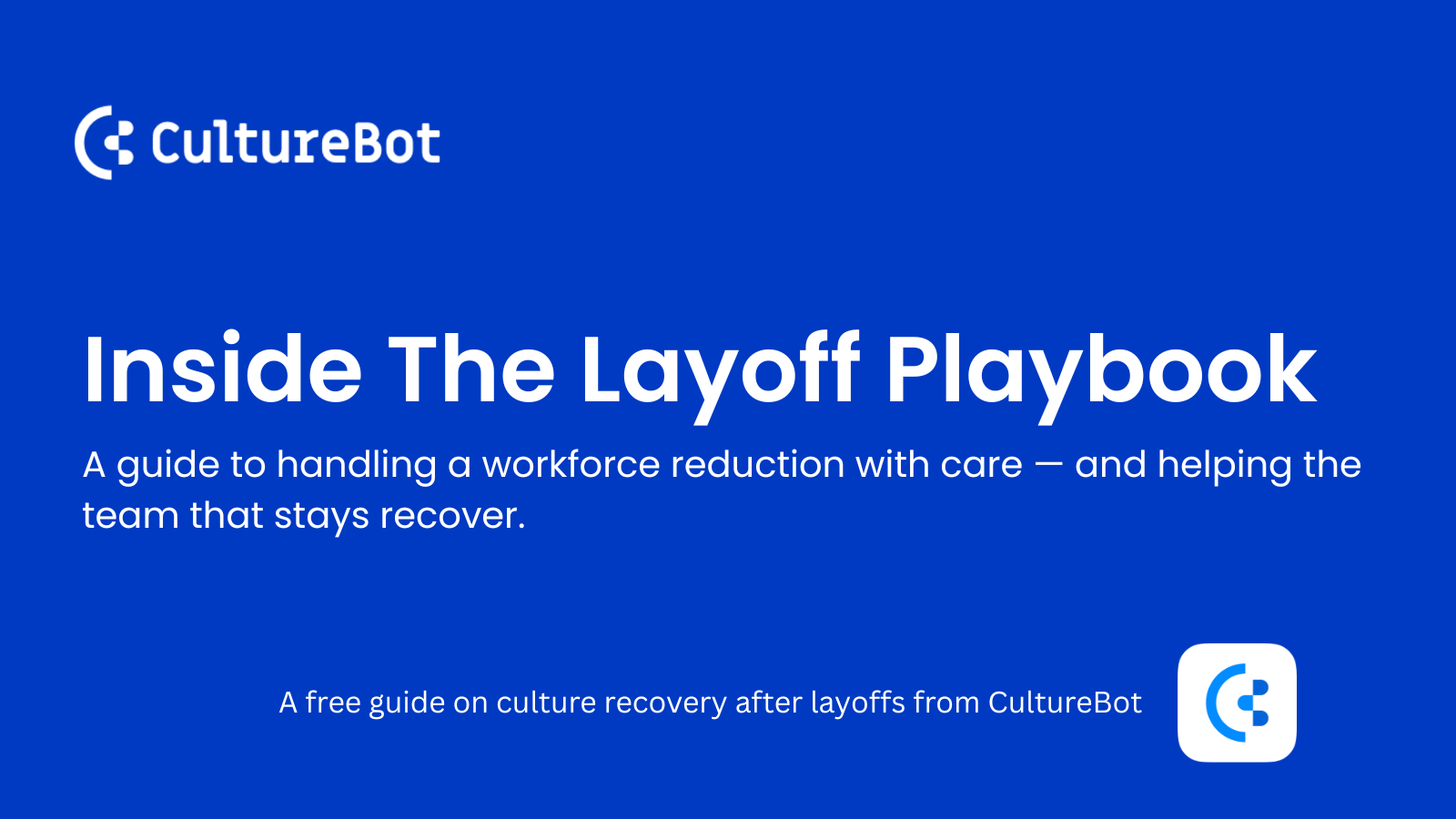
You can download The Layoff Playbook here.
If your team is already in the recovery window and you want to talk through what these patterns could look like inside your specific Slack or Teams setup, that’s something CultureBot is built for. We automate the cadences so HR doesn’t have to babysit four ongoing rituals on top of everything else. But honestly, the patterns work whether you build them by hand or with software.
HR doesn’t talk about how hard this part of the job is nearly enough. But we get through it together. We always do. 🩵