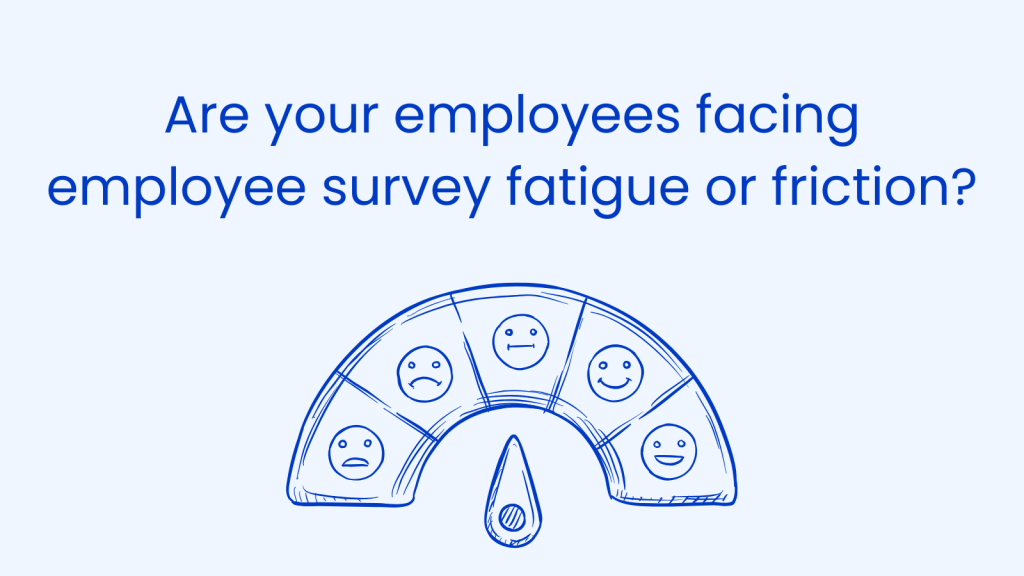
The real problem isn’t employee survey fatigue. It’s survey friction.
If your engagement survey takes 20+ minutes, lives in an email or employee portal no one logs into regularly, and takes leaders 90 days to act on results, it’s not measuring engagement. It’s eroding it.
Employees aren’t tired of giving feedback. They’re tired of:
- 20-minute surveys during an already overloaded week
- Logging into a platform they haven’t touched in a year
- “Anonymous” settings they don’t fully trust
- Watching their responses disappear into a black hole
That’s not engagement measurement. That’s friction layered on top of vulnerability. And friction kills participation before you even hit send.
Most People teams mistake this for employee survey fatigue. It isn’t fatigue. It’s friction.
This Isn’t Just About Engagement Scores
When survey data is incomplete or overly cautious, you don’t just get imperfect insights. You miss early warning signs:
- The top performer quietly taking recruiter calls
- The team that’s burning out but still hitting deadlines
- The new manager creating avoidable turnover
- The process breakdown hurting customer experience
Survey friction doesn’t just lower response rates. It hides risk. And hidden risk is expensive.
The Four Types of Survey Friction
1. Trust Friction
Even when you promise anonymity, employees quietly wonder: Can this be traced back to me? Will my manager see this? Is this really anonymous?
If trust is low, honesty drops. If honesty drops, your data becomes polite. You don’t get the truth. You get safety. Safety and politeness don’t create change, impact, or a competitive advantage in your business.
2. Time Friction
Long surveys signal something unintentionally: this is going to take effort. Your team is stretched, so they aren’t prioritizing a survey during peak hours, and they aren’t doing it during their personal time.
The longer it takes to complete your survey, the lower the response rate. The lower the response rate, the harder it is to act confidently.
3. Workflow Friction
If your survey lives in email or an external portal, it’s competing with 200 other notifications. Feedback outside the flow of work feels optional — and optional gets deprioritized. When logging in becomes frustrating, participation quietly drops.
4. Action Friction
Then there’s the delay. Reports get built. Slides get reviewed. Meetings get scheduled. By the time results are shared, the emotion behind the feedback is gone.
When feedback takes 60–90 days to matter, employees stop believing it ever will. That’s how surveys quietly train disengagement.
The Real Problem Isn’t Your Questions
When scaling a team as a VP of People, our challenge was never what to ask on an employee survey. It was how to remove the friction that gets mislabeled as employee survey fatigue.
How do we make feedback easy? How do we make it safe? How do we respond while it still matters and model a bias for action?
The issue isn’t survey design. It’s system design. If feedback lives outside daily workflow, it will always feel like an event instead of a rhythm. Engagement cannot survive as an event.
What a Real Feedback System Looks Like
A real system:
- Lives where work already happens
- Takes minutes, not chunks of a day
- Protects anonymity in a way employees trust
- Surfaces insights instantly
- Enables leaders to act within days, not quarters
When feedback lives inside the tool your team already uses eight hours a day, the loop shortens dramatically. Response rates increase. Candor improves. Momentum builds. Not because the questions changed — because the system did.
Worried About Employee Survey Fatigue? Pressure-Test Your System First
Before you launch, pressure-test your system. Ask:
- How long will this take to complete?
- Does anonymity feel unquestionably safe?
- Does it live inside a daily workflow?
- How fast can we visibly respond?
If you’re not confident in those answers, you don’t need better questions. You need a better system.
That’s exactly why we built CultureBot — to remove survey friction by delivering feedback inside Slack, protecting anonymity, enabling lightweight pulses instead of heavy downloads, and surfacing AI summaries instantly so leaders can act while the moment still matters.
If you’re looking to improve employee survey participation, we’re offering 30-minute Survey Strategy Sessions for People teams. Not a generic demo — a working session where we look at your current process, your friction points, and how to shorten your feedback loop. You’ll leave with a clear plan. If CultureBot is the right fit, great. If not, you still avoid another round of survey friction.