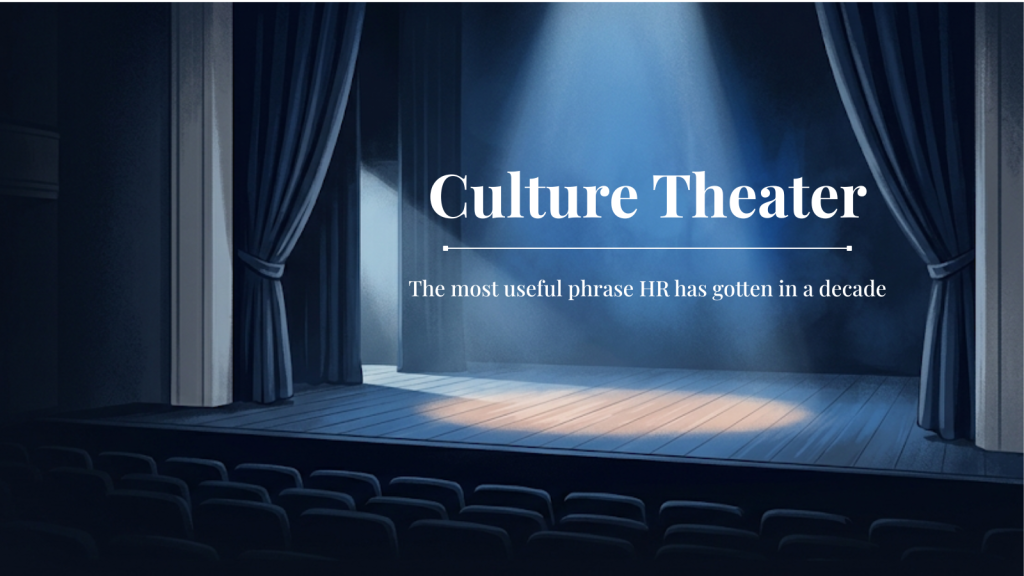
Last week, HR Executive ran a piece called “Culture theater? 10 persistent myths that keep organizations stuck.” The lede discusses the importance of an employee engagement strategy:
“The mandate for HR leadership is no longer to nurture company culture. It’s to engineer it. Measurably. Systemically. At scale.”
I read that and realized I’ve been waxing poetic about culture theater for years, I just never came up with the clever and very fitting name for it. In fact, I used to be very good at culture theater.
Not because I didn’t care. Because as a VP of People at a fast growing startup, I cared so much that I poured everything into the moments that were visible. The all-hands that actually landed. The offsite where the energy was real and the team left genuinely connected. The engagement survey with an 89% response rate that I was genuinely proud of.
Those things were good. I still believe that. That work definitely matters.
But I was measuring the wrong thing. I was prioritizing the moments when everyone was watching, and calling that the culture. What I wasn’t always measuring were the things that really landed the 360 days in between
Now, after nearly 15 years in the People Ops chair, both in-house and in the consultant and fractional role before founding CultureBot, I can name every form of culture theater on sight. HR teams around the globe right now are posting visuals about company values around their offices, but have no time to work on how those values actually show up in the work or company communication. They’re spending countless hours planning and executing the annual offsite where everyone “aligns,” but then they struggle to bring that alignment to actual life in the next quarter. They’re sourcing a new peer recognition platform that consumes a huge chunk of their already shrinking budget and promises to fix all of their engagement problems instantly, only to learn that a very few people ever even login to it.
Here’s the distinction I eventually landed on: working tirelessly on all-hands meetings, offsites, and engagement surveys isn’t the problem. It’s actually proof that your leadership cares. The problem is treating these big visible moments as the culture itself, instead of as one visible expression of a practice that should be running every single day.
Culture that actually passes the test
Your team may not remember that beautiful, inspiring speech your CEO gave at the offsite when next quarter they’re having their hardest week ever. They remember whether their manager noticed and checked in with them, offering help and support. They notice whether the recognition showed up in the channel where the work happened, not three months later in a formal (and often sterile) performance review. They notice whether the last time they gave hard feedback, it was actually safe to do so.
That realization changed where I put my energy
I stopped trying to over-engineer the big moments and started engineering the daily ones. Three things, specifically:
- Ritual. The practices that show up again and again, whether or not anyone important is watching. A weekly team question. A standing check-in that doesn’t get cancelled when the quarter gets hard. Programs that run on a cadence, not on someone’s memory.
- Recognition. Specific, timely, and close to where the work happened, not centralized in an HR platform that 12% of the company has logged into. A manager notices the right thing and says it out loud before it’s too late or they acknowledge important milestones their team members hit, showing genuine and timely gratitude for that time and effort.
- Real Talk. Feedback loops that move upward, not just downward. The signal that it’s safe to say the hard thing, built not only through a company value statement, but through what happened the last time someone said it. A shared understanding that the next big idea or improvement can come from anyone on the team.
It’s easy to get stuck in the theater
So many companies get stuck in the theater. I get it. The theater can be easier to defend in your budget meeting. A consultant produces a deck. An offsite produces photos. An award produces a badge for the careers page. The actual system, daily recognition, real-time feedback, manager check-ins that happen consistently, produces something quieter: a team that doesn’t break. That’s harder to point at in Q3 review, even when in reality it’s the only thing that matters.
Theater feels like progress. When the values get refreshed, when the all-hands lands well, when the new platform launches something happened. The reality of a culture that is actually making a long-term impact, is that most days, nothing visible happens. The system runs and the team feels it, but there’s nothing to celebrate at the leadership meeting on a weekly basis. That can be hard to defend to a board or a leadership team who needs HR to “check the culture and engagement box.”
Theater photographs better. The smiling-team-at-offsite photo. The award that becomes the badge on the careers page. None of these things produce culture, but they all produce evidence of culture. For most companies, the evidence is the goal, but evidence alone does not affect your bottom line.
Stop producing evidence of culture. Start prioritizing actual culture
None of this replaces the big moments entirely. The all-hands and the offsites still matter. But the intention you pour into planning that offsite, the care that goes into making people feel connected and aligned and genuinely part of something, that intention deserves to show up on a random Tuesday in July, not just once a year.
The system is what your team feels on that Tuesday afternoon when no one is watching. That system is the foundation of your company’s culture, and if that part is broken, no amount of theater is going to fix it.
That’s the reframe I keep coming back to.
The big moments are proof you know how to do this. The question is whether you’ve built a system that lets you do it consistently every day.
That’s what we’re building at CultureBot. Not a replacement for the human moments, but a system that makes sure they don’t only happen when everyone’s watching. Not theater. The foundational system underneath.
If you want to see what one looks like, book a demo, and let us explore how we can help you build a genuine, reliable culture that runs even when no one is looking, and actually affects your organization’s bottom line.