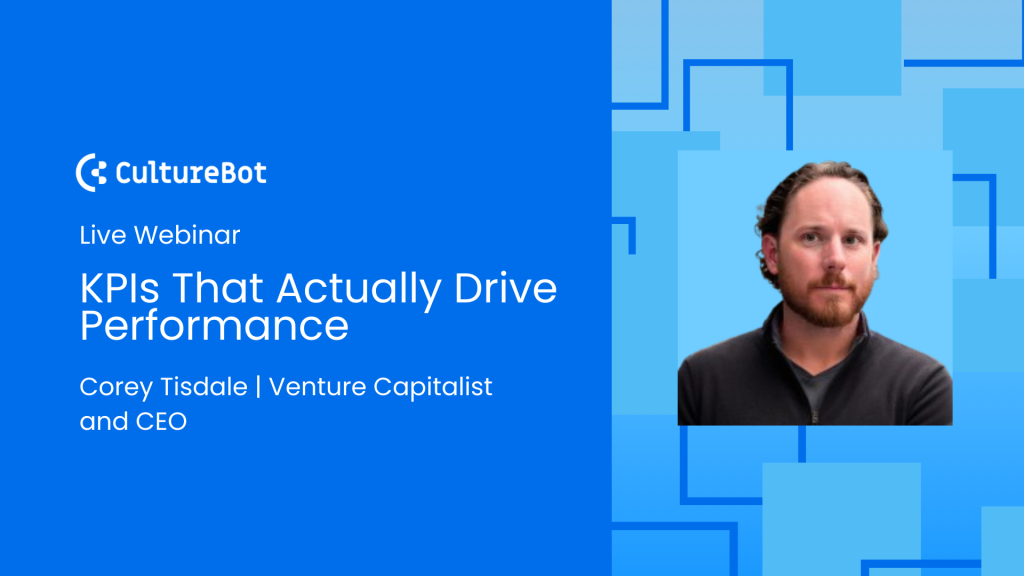
Most teams have KPIs. Far fewer have KPIs that actually change how people work. In our latest webinar, we sat down with Corey Tisdale — entrepreneur, operator, and someone who has scaled businesses from $0 to $200M — to dig into what separates a scorecard that gathers dust from one that drives real performance.
If you missed it live, the full recording is below.
About Corey Tisdale
Corey Tisdale is an entrepreneur who has built and scaled multiple businesses from the ground up — including BBQ Guys, which he grew from zero to $200M as Founder and CEO. He now serves as Managing Principal at Build With Shift, where he helps founders and leadership teams build the operational systems they need to actually scale. Corey brings a practitioner’s perspective to every conversation: he’s not talking theory, he’s talking from the trenches.
What We Covered
KPI conversations tend to break down in one of two directions: either a team has no KPIs and doesn’t know where to start, or they have so many that nobody can actually focus. Corey’s framework cuts through both problems by getting precise about what kind of measurement you’re actually dealing with.
Three types of measurement — and why mixing them up causes problems
One of the most useful things Corey shared was a simplified vocabulary for separating three concepts that often get lumped together:
Numeric Goals
These are outcome targets — a revenue number, a gross margin percentage. They define what success looks like, but they’re inherently backward-looking: by the time you know whether you hit one, the period is over. Numeric goals tell you whether everything else worked. They don’t tell you what to do today.
KPIs
True KPIs measure processes the business already runs repeatedly — things you do over and over to acquire customers, deliver on your brand promise, or get paid. A good KPI is controllable, predictive, and focused. For a sales team, revenue is the numeric goal; leads per month, close rate, and average first contact time are the KPIs. The target is roughly three to five per person.
Priorities
Priorities cover important work being done for the first time — opening a second location, hiring a CFO, integrating a new vendor. Because the steps aren’t known yet, forcing a KPI structure onto this work doesn’t hold up. Instead, define a clear outcome with milestones and a timeline, then review progress as on-track or off-track.
Building KPIs that actually stick
KPI systems fail when they’re built at one level of the org without the understanding or support of the level above. Corey’s approach starts with leadership clarity on direction, then works down — managers translate that direction into a small set of controllable measures their teams can actually influence.
A useful mental model: invert the org chart. Customers sit at the top, then frontline employees, then managers, with leadership at the base. Each layer’s job is to make the layer above it more successful. Managers reduce uncertainty for their teams by converting strategic direction into clear expectations.
He also made the point that KPIs rarely start as exactly right. Early on, revisit them quarterly — which ones measured performance well, which were close but mis-specified, which were just bad ideas. The system is expected to evolve as the business improves and the biggest constraints shift.
Cadence: how to run the meetings that make KPIs work
A KPI system without a meeting structure to support it tends to drift. Corey’s model keeps updates brief and factual: what’s on track, what’s slipping, what needs attention — no explanations, no excuses, just facts and next steps.
Commitments should match the meeting cadence. Daily huddles produce commitments due tomorrow. Weekly meetings produce commitments due next week. This prevents the common trap of an ever-growing list of unfinished items that never quite get closed out.
For leadership visibility, a simple red / yellow / green / super green roll-up works well. Each functional area surfaces its lowest status, and a single yellow triggers a plain-English explanation of what’s happening and what will be done about it. Leadership doesn’t need to see every KPI across operations — they need to know where to focus.
“When performance is poor and the people are right, the system is the lever.”
The work becomes defining what “good” looks like, trusting teams to execute, and selecting a small number of checkpoints that indicate whether execution is headed in the right direction. — Corey Tisdale
Corey’s Reading List for Leaders Who Want to Build Better Teams
Corey shared the books that have shaped how he thinks about building teams, setting expectations, and making hard calls. He recommends reading them roughly in this order — but any subset is worthwhile.
The E-Myth Revisited — Michael Gerber
A foundational read on why so many businesses fail — and why entrepreneurs so often end up trapped working in their business instead of on it. If you’ve ever felt like you built yourself a job instead of a company, this is where to start.
The One Minute Manager — Ken Blanchard
A short, practical guide to managing people in a way that respects their time and makes them feel empowered. Blanchard’s framework for quick, intentional check-ins is something you can start using immediately.
Rhythm — Patrick Thean
This one is squarely in KPI territory. Thean walks through how to structure your meeting cadences, what belongs in them, and what your tracking dashboards should actually look like. His site also has simplified job scorecard templates worth bookmarking.
Flourish — Todd Smart
Built around the Bloom Growth coaching system, Flourish is about creating a business you actually love leading — one that energizes rather than drains both you and your team. A good read if you’ve been grinding and wondering why it doesn’t feel like it’s working.
Topgrading + Who — Brad Smart & Geoff Smart
Two books on hiring, written by two different members of the Smart family (no relation to Todd Smart, for the record). Corey recommends reading both — they complement each other and together form a solid hiring philosophy. If your team KPIs are struggling, it might start at the hiring stage.
Thick Face, Black Heart — Chin-Ning Chu
Save this one for when you’re staring down a hard decision. Chu’s book is about the mental fortitude it takes to make the calls leaders need to make — without losing yourself in the process. A fitting close to the list.
Want to keep the conversation going?
CultureBot helps teams build the visibility and accountability structures that make KPIs more than just a spreadsheet exercise — right inside Slack and Microsoft Teams.
See How CultureBot Works →