Free guide • 30 questions
This free guide gives you 30 ready-to-use pulse survey questions across six pillars of engagement. They come straight from the statement bank behind CultureBot’s Engagement Pulse, written and reviewed by our team. Copy them, adapt them, and use them with your team this week.
Quick answer
Good pulse survey questions are short statements people can rate in seconds, cover several parts of engagement, and rotate so nobody sees the same one every week. Strong examples include “I feel valued for the work I do here,” “My manager listens to my ideas,” and “My workload is manageable.” Ask about five every week or two, and add the eNPS question once a month.
What’s inside
✓ The 30 questions, by pillar
✓ A ready-to-run 6-week pulse plan
✓ The eNPS question to add monthly
✓ How often to ask
✓ How to roll it out and close the loop
✓ Bonus: run these questions automatically in Slack
Why pulse surveys matter right now
29%
of U.S. employees are engaged at work, the lowest level since 2011
37%
strongly agree someone at work cares about them, down from 40% earlier this year
47%
of employees feel pressure to hold back feedback at least sometimes
Sources: Gallup, October 2026 and Visier via HR Dive, 2025.
U.S. engagement just fell to its lowest point in more than a decade, and fewer people feel that someone at work cares about them. On top of that, nearly half of employees sometimes hold back what they really think. A short, frequent check-in makes it easier to answer honestly, and it shows people that someone is listening all year.
Pulse survey vs. annual engagement survey
| Pulse survey | Annual survey | |
|---|---|---|
| How often | Every week, 2 weeks, or month | Once a year |
| Time to answer | About a minute | Often 20 minutes or more |
| When you see results | Within days | Weeks or months later |
| What it’s good for | Spotting trends and acting early | A deep, once-a-year baseline |
| Survey fatigue | Low, if questions rotate | High, with long forms |
Many teams keep a yearly deep dive and add a pulse for the months in between. Others find the pulse tells them what they need and retire the annual survey altogether.
Engagement Pulse for Slack
Want these questions sent for you?
CultureBot’s Engagement Pulse asks your team five quick statements in Slack every week or two, tracks the results, and lets you reply to comments. No survey to build, no answers to chase.
30 pulse survey questions to use with your team
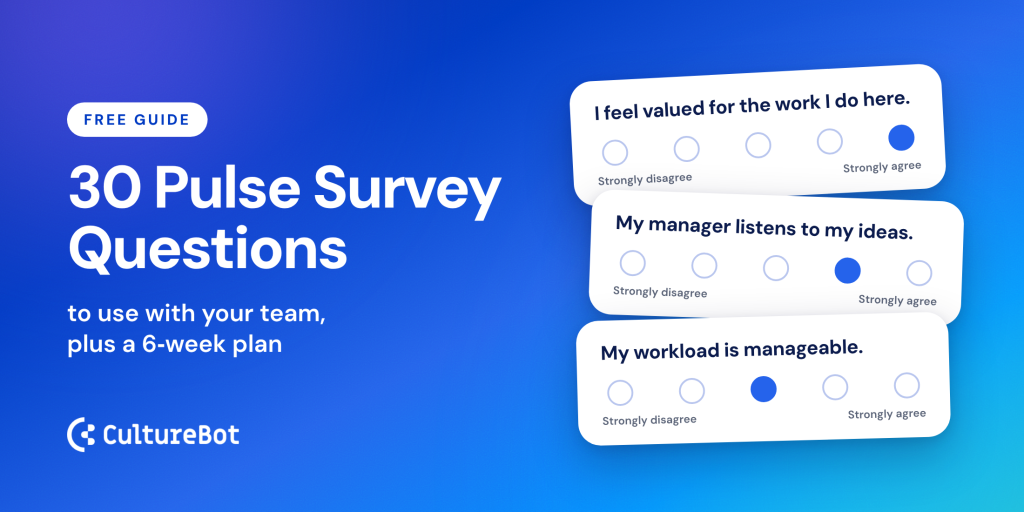
Each one is a statement people rate on a five-point scale, from Strongly disagree to Strongly agree. Use them as written, or swap in your company’s language. Here’s what one looks like in Slack:

1. Recognition
What it tells you: Whether people feel their work is seen, by their manager and their peers.
□ I feel valued for the work I do here.
□ My manager recognizes the contributions I make.
□ My peers recognize the contributions I make.
□ The recognition I receive is meaningful to me.
□ I am recognized soon after I do good work.
If scores dip: Make recognition visible and specific, so good work gets noticed in the moment. Our guide to building a culture of recognition shows how.
2. Voice
What it tells you: Whether people feel safe speaking up, and believe it leads somewhere.
□ People here can openly disagree with leaders.
□ People here raise concerns openly.
□ Leaders here are open to hearing about problems.
□ Good ideas lead to change here.
□ When concerns are raised here, leaders take them seriously.
If scores dip: Reply to comments and share what changed because of them. See how to respond to anonymous employee feedback.
3. Management
What it tells you: Whether managers set clear expectations and support their people.
□ I know what my manager expects of me.
□ My manager communicates clearly with me.
□ My manager is easy to approach when I need help.
□ My manager listens to my ideas.
□ My manager supports my professional growth.
If scores dip: Give managers an easy view of their team’s wins before 1:1s. Here are 5 ways to nudge managers toward better recognition.
4. Team
What it tells you: Whether people trust each other and feel connected, on their team and across teams.
□ I trust my teammates.
□ My teammates help each other when the workload is heavy.
□ I feel connected to my teammates.
□ My team welcomes new people.
□ Other teams here are willing to help my team.
If scores dip: Create easy ways to connect across teams, like rotating coffee chats or a shared channel for cross-team wins.
5. Growth
What it tells you: Whether people see a future here and feel their work matters.
□ I have opportunities to grow here.
□ I am developing my skills here.
□ I can see how my career could progress here.
□ The work I do matters.
□ I can see the progress I am making in my work.
If scores dip: Make growth a regular 1:1 topic, and point out the progress people have already made.
6. Wellbeing
What it tells you: Whether the workload and pace are sustainable.
□ My workload is manageable.
□ The pace of my work is sustainable.
□ My personal time is respected here.
□ I have the flexibility I need in my schedule.
□ I have time to focus on my most important work.
If scores dip: Look at workload and meeting load together, and protect time for focused work.
CultureBot’s bank has nearly 100 statements across ten pillars, giving you a full 360-degree picture of employee experience and engagement. Our Engagement Pulse runs automatically for your employees, right in Slack.
A ready-to-run 6-week plan for your pulse survey questions
Not sure where to start? Here’s all 30 questions as a six-week plan. Each week has five statements, about a minute to answer, and every question appears once. Run it weekly, or every two weeks for a full quarter.
| Week | Five statements to send |
|---|---|
| Week 1 + eNPS | Recognition: I feel valued for the work I do here. Voice: People here raise concerns openly. Management: My manager is easy to approach when I need help. Team: My team welcomes new people. Growth: I can see the progress I am making in my work. |
| Week 2 | Recognition: My manager recognizes the contributions I make. Voice: Leaders here are open to hearing about problems. Management: My manager listens to my ideas. Team: Other teams here are willing to help my team. Wellbeing: My workload is manageable. |
| Week 3 | Recognition: My peers recognize the contributions I make. Voice: Good ideas lead to change here. Management: My manager supports my professional growth. Growth: I have opportunities to grow here. Wellbeing: The pace of my work is sustainable. |
| Week 4 | Recognition: The recognition I receive is meaningful to me. Voice: When concerns are raised here, leaders take them seriously. Team: I trust my teammates. Growth: I am developing my skills here. Wellbeing: My personal time is respected here. |
| Week 5 + eNPS | Recognition: I am recognized soon after I do good work. Management: I know what my manager expects of me. Team: My teammates help each other when the workload is heavy. Growth: I can see how my career could progress here. Wellbeing: I have the flexibility I need in my schedule. |
| Week 6 | Voice: People here can openly disagree with leaders. Management: My manager communicates clearly with me. Team: I feel connected to my teammates. Growth: The work I do matters. Wellbeing: I have time to focus on my most important work. |
Don’t forget the eNPS question
Once a month, add the employee Net Promoter Score question:
eNPS question (0 to 10)
How likely are you to recommend working here to a friend?
The score runs from -100 to +100, and it’s one of the easiest numbers to track over time. Always give people room to explain their answer. The “why” tells you more than the number. Our guide, What Is a Good eNPS Score?, covers benchmarks and how to improve yours.
How often should you run a pulse survey?
• Every week: best for fast-changing teams, or the first few months after a big change like a reorg.
• Every 2 weeks: a strong default for most companies. Frequent enough to spot trends, light enough to avoid fatigue.
• Monthly: good for smaller teams or companies trying a pulse for the first time.
Whatever you choose, keep it short. Five statements is plenty. The habit of answering matters more than the number of questions.
How to roll out a pulse survey and close the loop
1. Pilot with one team
Start with a team whose manager is excited about it. You’ll learn what questions land and how people react before you go company-wide.
2. Tell people why, and what happens next
Say who will see results, how privacy works, and what you’ll do with what you learn. People answer more honestly when they know the rules.
3. Share results with leaders
Get scores and comments in front of the people who can act on them, like your exec team and managers, on a regular schedule.
4. Close the loop
Reply to comments, share what you heard, and name one thing you’ll change. Our guide on how to respond to anonymous employee feedback has reply examples you can use.
5. Protect small groups
Hide scores until enough people have answered. A common rule is at least five responses, and more for sensitive topics like pay and stress.
Skip the spreadsheet: run these questions automatically in Slack
Sending questions, chasing answers, and building charts by hand adds up fast. CultureBot’s Engagement Pulse does it for you. Each week or two, your people get five short statements in Slack, drawn from the same bank as this guide. Once a month, the pulse adds the eNPS question, and nobody sees a statement they answered recently.
• No survey to write. 98 statements across ten pillars, rotated for you.
• Results you can act on. Scores for each pillar, an overall score, eNPS, and participation, with trends month by month.
• Privacy built in. Scores only show once at least 5 people have answered, or 8 for sensitive statements like pay and stress.
• Leaders in the loop. Share a scorecard and new comments in private Slack channels, no admin access needed.
• A real conversation. Reply to comments in Slack. Names stay hidden unless people choose to share them.
Engagement Pulse is available on the CultureBot Pro plan. For setup steps, see Set up Engagement Pulse, or read about everything else in our CultureBot Q4 2026 Product Updates.
Pulse survey FAQ
What are good pulse survey questions?
Good pulse survey questions are short statements employees can rate in seconds, such as “I feel valued for the work I do here,” “My manager listens to my ideas,” and “My workload is manageable.” Cover several pillars, like recognition, voice, management, team, growth, and wellbeing, and rotate them so people don’t see repeats.
What pulse survey questions should I ask about managers?
Try “I know what my manager expects of me,” “My manager communicates clearly with me,” “My manager is easy to approach when I need help,” “My manager listens to my ideas,” and “My manager supports my professional growth.”
What is the difference between a pulse survey and an engagement survey?
An annual engagement survey asks dozens of questions once a year. A pulse survey asks a few short questions every week, 2 weeks, or month, so you see changes as they happen and can act sooner.
What is a pulse survey?
A pulse survey is a short, frequent employee survey, usually three to five questions every week, 2 weeks, or month. It gives leaders a steady read on engagement between longer annual surveys.
How many questions should a pulse survey have?
Three to five. Short pulses take about a minute and get higher participation. Rotate questions so people don’t see the same ones every time.
How often should you send a pulse survey?
Every 2 weeks is a strong default for most companies. Weekly works during big changes, and monthly works for smaller teams or first-time pulses.
Are pulse surveys anonymous?
It depends on the tool. In CultureBot’s Engagement Pulse, your company never sees who wrote a comment unless the person chooses to share their name, and scores only show once at least 5 people have answered.
Can you run a pulse survey in Slack?
Yes. CultureBot’s Engagement Pulse runs in Slack. People answer five statements in about a minute, and admins see results by pillar, eNPS, and comments they can reply to.
Put these 30 questions to work in Slack
Book a demo and we’ll show you Engagement Pulse running these questions in Slack, from the first statement to the results your leaders see.