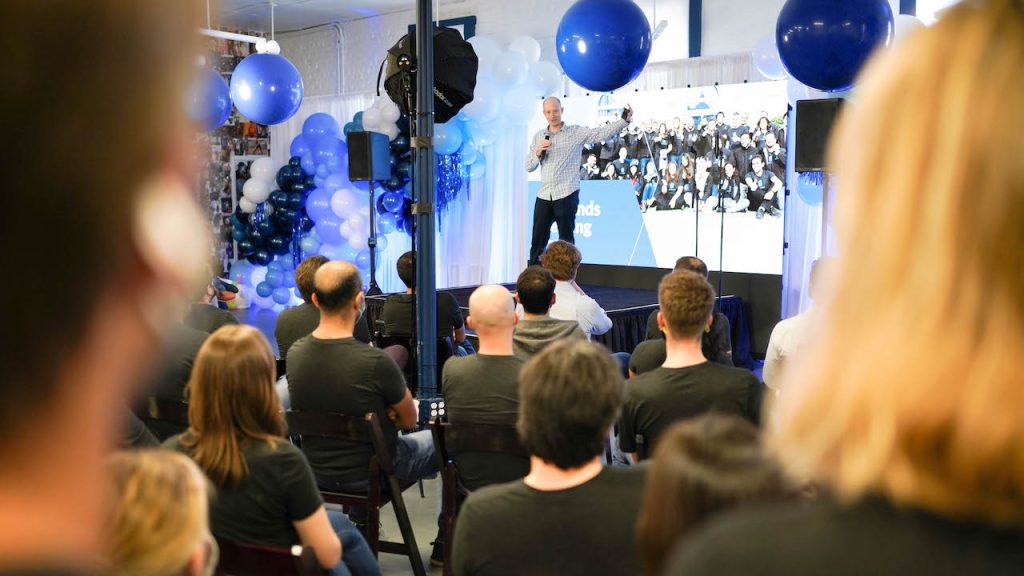
CEOs, Execs, Leaders, and People Ops professionals all around the world stare down the end of the year with an eye toward rallying their teams in the year ahead. The annual meeting is an important communication opportunity.
I believe that leading is about communicating, and communicating can be an extremely beautiful craft that pulls people together to create extraordinary things.
I orchestrated annual meetings at Levelset for 10+ years.
Here are some thoughts on conducting a successful annual all-hands, and getting a group poised to succeed together.
Communication Is A Result
Let me start with a short ode to “communication.”
Here’s a mantra: communication is not an activity, it’s a result.
It’s the process of getting something inside your head into someone else’s brain.
And it starts with understanding the “something” inside your own head.
Then articulating it (See: The Elements of Eloquence).
Then making it stick (See: Made to Stick).
And, importantly, influencing and motivating people to execute on it (See: Psychology of Influence, and Power of Moments).
You are well served to work on being a master of each one of these steps, and certainly, avoid skipping any of them.
Your #1 Goal Is To Build A “Shared Fate”
People spend a lot of time conjuring up, word-smithing, and documenting their company’s plans, objectives, and key results. There’s no shame in this, and it’s an important thing to do. But do not get hypnotized by the pleasures of getting all these objectives and key results in neat little rows, columns, and cells, and then prance around your organization trying to “communicate” them. That’s secondary, or worse.
You have 1 task as the leader: to generate the grit you’ll need through the year.
In reflecting on my job as a CEO, I’ve come to think of the role as just the “chief resiliency officer.”
Building a successful company is so, so hard, as companies constantly encounter expected and unexpected headwinds. A huge success hack is just building cultures and teams that can withstand the turmoil, and at best, feed off them. A team who can Fall Seven and Rise Eight.
But, of course, that’s easier said than done. You can’t just wish for your team to have “grit,” to ask them pretty-please have grit, or to hire a consultant to run the grit project.
You just have to come by this honestly.
Masterfully communicating and articulating the annual plan can get people to visualize the months, quarters, or years it’ll take to accomplish them, and you can gain an alliance with people on your team to get to that destination.
I love this quote from Phil Jackson in his book Eleven Rings:
The essence of coaching is to get the players to wholeheartedly agree to being coached, then offer them a sense of their destiny as a team.
This. Is. Everything.
There’s so much wisdom in this which stretches to what you need to do when building an organization.
I love to chuckle when leaders tell me they are “about winning.” Whatever. Phil Jackson, a man whose career was built on needing to literally “win,” has it more correct:
…obsessing about winning is a loser’s game: The most we can hope for is to create the best possible conditions for success, then let go of the outcome.
Any good leader will reiterate this, from football (Bill Walsh, The Score Takes Care of Itself), to business (Bill Campbell, the Trillion Dollar Coach).
The point? Don’t get confused about the goal of your annual meeting.
The annual meeting and your leadership is not about game planning on how to win and all the Xs and Os of the plan. It has nothing to do with that. It’s about creating the best conditions for success, getting people to agree to be led, giving people a sense of shared destiny as a team, and building some alliance around that.
The Feelings You Want People To Remember
Every company will list their annual priorities at the annual meeting.
Duh!
We did it [quickly]. You’ll do it, too. It’s fine.
But it’s not the thing. It’s not even remotely the thing.
One year, 5 minutes after the annual meeting, we went around the building with a camera, microphone, and $10 gift cards to a neighboring coffee shop. The offer: Name 2 of the 5 company priorities and get a free gift card (by the way, note how we immediately started repeating a message with a fun video/new format, a key to good communications).
I was not surprised to see that people remembered barely any of the priorities. Getting people to remember the priorities was going to take repetition and year-long communication consistency.
But people always remembered the feelings from the annual meeting.
Year-in and year-out, these feelings were always the same:
- Belonging
- Pride
- Alliance
- Appreciated
- Motivated
If you get these 5 things right, the execution and “winning” will take care of themselves.
You can deliver all 5 of these in a great, thoughtful annual meeting.
This is how.
Belonging: Where You’ve Been
Years ago, I came across this lovely New York Times piece about stories: The Family Stories That Bind Us. The “Do You Know Scale” really stuck out to me:
The more children knew about their family’s history, the stronger their sense of control over their lives, the higher their self-esteem and the more successfully they believed their families functioned. The “Do You Know?” scale turned out to be the best single predictor of children’s emotional health and happiness.
I figured that this very much applies to organizations, too.
And thus, a big part of our annual meeting, was making sure everyone knew the “family’s” history, and felt like they belonged to it and were a part of it.
In the early days, we talked through our history with slides and photos, and as our history got longer, we expanded this opening section to an introduction video. We made sure to include every office, old stories and new stories alike.
Don’t suck at this.
Don’t let just anyone at the company write some history biography. You write it. Involve some of your best communicators. Two Levelset rockstars who really poured gasoline onto this was our content leader, Alexander Dunn, who could always tell fantastic stories, and Gretchen Riedel, our employee #1 who had the culture pulse under thumb at all times.
Tell a story. Find the emotion. Your story is not a Wikipedia entry, or the thing you write up for page one of your one-day IPO package.
This is your family and your family’s story. It’s intimate. It has highs and lows. It’s true. People feel it.
Pride: Where You Are
The company’s history will make folks feel proud of the organization, but keep pushing on the pride button by highlighting all the things that you’ve accomplished together.
I love a take-away from the great Chip Heath and Dan Heath book on change management, Switch:
People find it more motivating to be partly finished with a longer journey than to be at the starting gate of a shorter one. One way to motivate action, then, is to make people feel as though they’re already closer to the finish line than they might have thought.
Highlighting where you are today as an organization, and what milestones you’ve already crossed off the board, will get people feeling proud of what they’ve done so far, and motivated to reach for those next things.
In our “Where We Are” section, we would always review a list of milestones captured over the previous year. By highlighting these milestones, we were celebrating the accomplishments thus far and how far we’ve come (i.e. pride), and getting people bought in toward the next few milestones on the list. They were always so, so close!
Alliance: Where You’re Going Together
This next section is where you’ll pull out the next year’s OKRs and priorities, but remember, deeply explaining these objectives is not your goal.
Your goal is getting people committed to delivering them, and in alliance with their teammates and the organization to seeing them through.
Those seem like similar goals, but are quite different.
One of my least favorite ways of running this section of an annual meeting is getting myself or executives to present a slide on each annual objective.
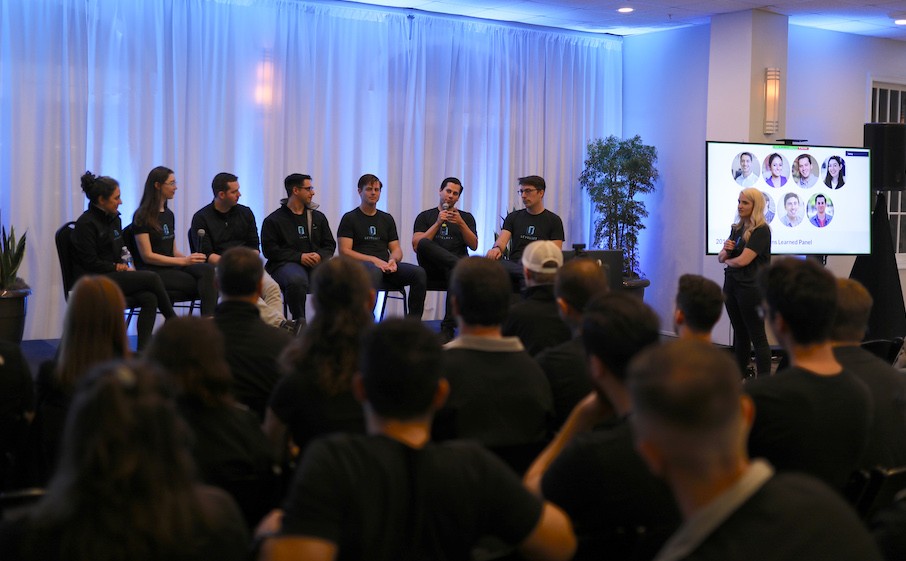
One of my favorite ways that we’ve done this section is when we put together a panel of 7-8 non-executive managers and leaders to have a slightly moderated conversation about the lessons from the past year and how those lessons are baked into the next year’s goals. In this format, you can mix in:
- Introducing the OKR;
- Involving trusted non-execs who will speak concretely to them;
- Discussing how the OKRs genuinely came to be;
- Identifying why the OKRs are important to everyone.
Appreciated: Say Thank You
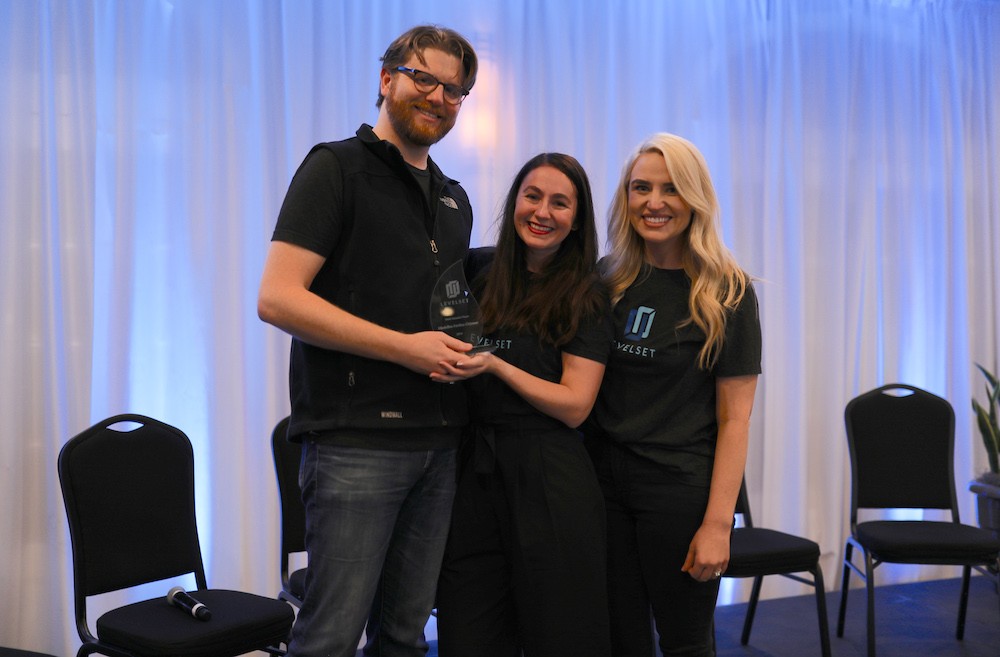
Now that Levelset is sold, people commonly ask me for regrets., and the #1 regret I carry is that I didn’t say “thank you” enough. Showing appreciation was always part of our annual meeting, and it always stole the show.
We would give out “Thumbs Up” across the organization each month, and then a “Thumbs Up Winner” every year. Our super talented people leaders, Jami Smith and Madeline Chizmar, came up with the idea of turning this into a “MVP” award at the annual meeting. We would name MVPs connected to each of the previous year’s Objectives.
The executive closest to the Objective would present the MVP award, which typically came with a lot of tears and a heartfelt description of the person’s contribution. And this MVP process communicated so many things at once: Appreciation to the MVP, how involved and committed our executives were, how genuine relationships were at the company, etc.; and it also re-iterated and created a reputation around the objectives themselves.
Read more about how to do recognition right here: CEO Recognition Playbook: Build Culture Through Shoutouts.
Motivated: Frame Your Story
Now you’re at the end of your annual meeting. It’s time to tie everything together and to motivate.
This is a huge opportunity for you to frame the big story: why does this company exist, where is the world going, and how does your company fit in?
This is a huge opportunity for you to motivate: What is the pithy, snappy thing you want to get across that you can bring up throughout the year, again and again and again, to keep motivating the team and keeping them working on the right things?
We would spend a lot of time working on this.
One year, when we knew we’d be investing heavily in fintech offerings, we crafted a theme and story around “Show THEM The Money.”
This became a huge thematic success.
We had examples all over the place where we were delivering value to different customers, and it touched every department in some way. We brought up examples in almost every weekly and monthly meeting throughout the year, and it helped frame the company’s story for that year: delivering more fintech offerings.
I’m convinced that leadership is basically storytelling.
The more perfect you get your story, and the more you can get everything you do to rhyme, the better.
Teams start to just read each other’s mind because everything starts to make so much sense. It’s the holy grail.
The annual meeting is a success when you frame the story for the year and you manage to couch it within the bigger, broader story of your company, the market, and your opportunity. It’s a motivator, and you’ll pull deposits from that motivation bank account all year long to plow through all the headwinds-to-come, and crush the goals.
Conclusion: You Get 0 Points For Communication Activities
So there you have it.
My advice: Don’t overlook the value of a great annual meeting, and great story telling.
And right after you put all this together, there are two things to keep in mind:
First, Repeat: Everything you want people to remember, you have to keep packaging it up, and delivering it, over and over and over again. Communication is a result. You get 0 points for writing things down, saying things, emailing things, circulating things, etc.
You only get points when ideas get implanted into other people’s brains.
And that requires being great at articulating the message, repeating yourself, mixing formats, and doing it over and over again.
Second, Just Keep Doing This Meeting: All of this stuff isn’t important for just the annual meeting, but for virtually every all-hands meeting. You can repeat small versions of this at every monthly and quarterly meeting.