
“What are the sweetest words in the world?,” someone once asked the clever, beautiful writer Oscar Wilde. He replied, “well done.”
Recognizing a job well done is perhaps the most silver bullet in a leader’s chamber.
It’s perfect. The giver feels gratitude. The receiver feels appreciation.
And – as I’ll show throughout this post – when used well, little acts of recognition can be the CEO’s most perfect communications strategy to model behaviors, spotlight priorities, and energize teams.
Recognition is Leadership Marketing

In Ride of a Lifetime, mega-successful CEO Bob Iger writes about stumbling onto an effective communications strategy: “communication-by-press-release.” That is, when he wanted a message to cut through all the noise and really stick, he would built it into a press release. Iger writes:
The team knew how serious I was…but hearing it communicated broadly, particularly to investors, and witnessing the reaction to it, fueled everyone with the energy and commitment to move forward…
…At some point over the years, I referred to a concept I called “management by press release” – meaning if I say something with great conviction to the outside world, it tends to resonate powerfully inside the company.
This is insightful and brilliant, and a very effective internal communications strategy. I too noticed that I could leverage my external communications – in interviews, to investors, to the board, etc. – to get the internal teams’ attention. People pay a lot of attention to what the CEO cares about.
The same principles hold by stretching Iger’s thesis into messages a CEO sends internally. And specifically, internal-messages-by-recognition.
When the CEO recognizes someone’s work, it serves as an enormous signal to the other leaders and the whole team about what the CEO is paying attention to, and what he/she values.
Everything Iger loves about press releases, I loved about recognition.
But more so, because recognition could happen more often and it even made me feel good.
Here are some important principles to keep in mind:
- Be Focused. If recognition isn’t anchored to something than your message has no focus. In other words, be intentional. What are the core things you want your team and leaders to pay attention (your mission? values? annual priorities?)? Well, when work happens unrelated to those things, don’t mention it. Spotlight only what you want in the spotlight.
- Be Consistent. I used to send a message every Monday morning. It followed an exacting format that collated all the recognition under my key messaging themes. These messages were extraordinarily consistent. They came like clockwork. They trained the team to think about their work according to these key themes that I noticed.
- Be Authentic. People can tell when you aren’t involved in drafting a message or “Shoutout.” Don’t get your EA to draft this stuff. Spend real time on it. Don’t publish anything that you don’t truly understand.
- Be the company’s #1 Spotter: I would write some Shoutouts personally, but more often, I was just a spotter. I was the company’s #1 spotter of work well done when someone embodied our mission, demonstrated a value, or contributed to a company goal. I spotted, and then advertised it to the rest of the team.
CEOs are marketers of culture, and recognition is their campaign.
The Power of Names in CEO Communication

Your company has Core Values and behaviors you want people to model. You have annual goals and priorities you want people to achieve and focus on. Your company has a mission you want to guide its work and motivate.
CEOs and leadership teams spend a lot of time coming up with these. The best leaders spend a lot of time figuring out how to communicate them so that the mission, values, and goals live prominently in their teams’s minds.
But how do you get people to remember?
My #1 answer: Names.
Getting internal teams to remember and really know your company’s mission, values, and goals is a messaging and marketing job.
When it comes to getting messages remembered, the Heath Brothers provide my favorite framework in Made To Stick. And the framework’s most critical element is to be concrete.
The best way to be concrete is to use people, stories, and names. “Language,” writes the Heath Brothers, “is often abstract, but life is not abstract.” Names and people are not abstract, and people care about and remember people.
Names and people are the ultimate communication silver bullet, and carry culture further than abstract words ever can.
I love the story of The Daily Record, a local newspaper profiled in Made To Stick, whose editor emphasized “names” over all other content. The editor was quoted:
I’ll bet that if the Daily Record printed the entire county telephone directory tonight, half the people would sit down and check to be sure their name was included…When somebody tells you, “Aw, you don’t want all those names,” please assure them that’s exactly what we want, most of all!
This was a huge inspiration to my leadership style, and “recognition” of names became a dollar spent that got a huge multiple.
People understand people. By spotting and highlighting names at key moments – and always attaching a name to our goals, values, or mission – we created a high-performing cultural machine.
Why CEOs Must Lead Recognition to Build Culture
I helped a group acquire and now build CultureBot because of how much we believed in the power of great cultures. Our group includes People Ops and HR leadership. But we’re not a fan at all of the status quo with recognition software (like CultureBot). These platforms are all “HR Tech” with an HR buyer.
To me, HR is not and should not be the leadership on recognition.
Recognition is not an HR program. It’s a CEO’s most powerful communication tool.
HR and People Operation groups face an enormously steep climb to create thriving recognition programs. They simply don’t have a good entry point into the team. All launches are too much of “a program” instead of an embedded leadership quality.
The CEO – by contrast – has an incredibly powerful voice here, and can get recognition streaming through the company like a knife through butter.
And then, you’d be amazed how quickly “recognition” will cascade through the entire organization. Leaders everywhere will be popping off recognition modeling the CEO’s framework and behaviors. Peer-to-peer recognition will instantly become commonplace and model the leadership.
No rules, policies, guidelines, or prompting required. The only requirement is a CEO who understands these 3 simple items:
- Management-via-recognition
- Be the #1 Spotter of great, goal-aligning work
- Names, names, names
Team Recognition Goes Beyond Employee Recognition
Who is the “team?”
CEO’s juggle a lot of different stakeholders: employees, partners, independent contractors and freelancers, advisors, executives, customers, board members, investors….
None of these live in a silo, and all of them must engage and work together with some degree of shared context.
This brings me to another reason why HR is the wrong outfit to lead recognition – because HR largely only sees the employee stakeholder.
CEOs must think broadly about their “team.” And they should think broadly about how they use recognition to weave the full group of stakeholders together.
While CEO, for example, I would bring our freelancers, advisors, board members, and more directly into recognition messages. After all, I wanted all of these stakeholders to understand our mission, values, and goals. I wanted them 100% bought in. I wanted freelancers to prioritize our projects over others. I wanted board members to be just as energetic about our risky bets and our ability to pull out of ruts. I wanted advisors to have all the context.
When CEOs are looking to be the #1 spotter of great work that is well aligned to the mission, values, and goals….they must look everywhere, and bring as many stakeholders together as possible.
CEO Recognition Playbook
“Running a business is a design job,” said Alan Mulally, the well-known Ford turnaround CEO. The concept is repeated across all of the leadership greats (read: American Icon).
The point is for CEOs and companies to spend time thinking about how to design team recognition so that it’s more consistent and effective, rather than disjointed and non-compounding one-off “thank yous” floating around in email, Slack, Teams, or in all-hand decks.
Here are some recognition ideas as part of a CEO recognition strategy, and a CEO Recognition Playbook.
1. Be Clear On What You Want To Spot (Goals, Values, Mission)
Leadership is articulation. The very first part of effectively communicating anything is to be really clear, simple, and crisp on what you actually want to get across.
A CEO’s recognition plan must be for the purpose of getting messages through to the team. Messages such as:
- Mission: This is why we exist and why it’s important;
- Values: This is how we behave and make decisions;
- Plan: This is what’s most important right now.
Get clear on these 3 items. Write them down and post them on your computer monitor or wall. Because you want to spot people doing great work on these specific things.
2. Build A Spotting Machine
It’s difficult for CEOs and other executive leaders to be everywhere and see everything across a company. In fact, as Intel’s Andy Grove wrote, it’s too often that the CEO is the “guy always last to know.”
So CEOs and leaders need to design up a “spotting machine.” This is a designed environment that acts to surface great work. My “spotting machine” had a few different shoots:
- Emoji Tracking: We created a “Best Of” custom emoji. Whenever someone spotted great work, they clicked the emoji, and it posted the work in a “best of the week” channel.
- Lines of Communication with Culture Carriers: I’d reach out to our culture carriers and ask them directly to surface the good work around our mission, values, and plan.
- Tracked Key Channels & Feeds: We had a few key channels and data feeds hosting key team activity, and I watched these channels closely.
3. Create A Routine Recognition Message
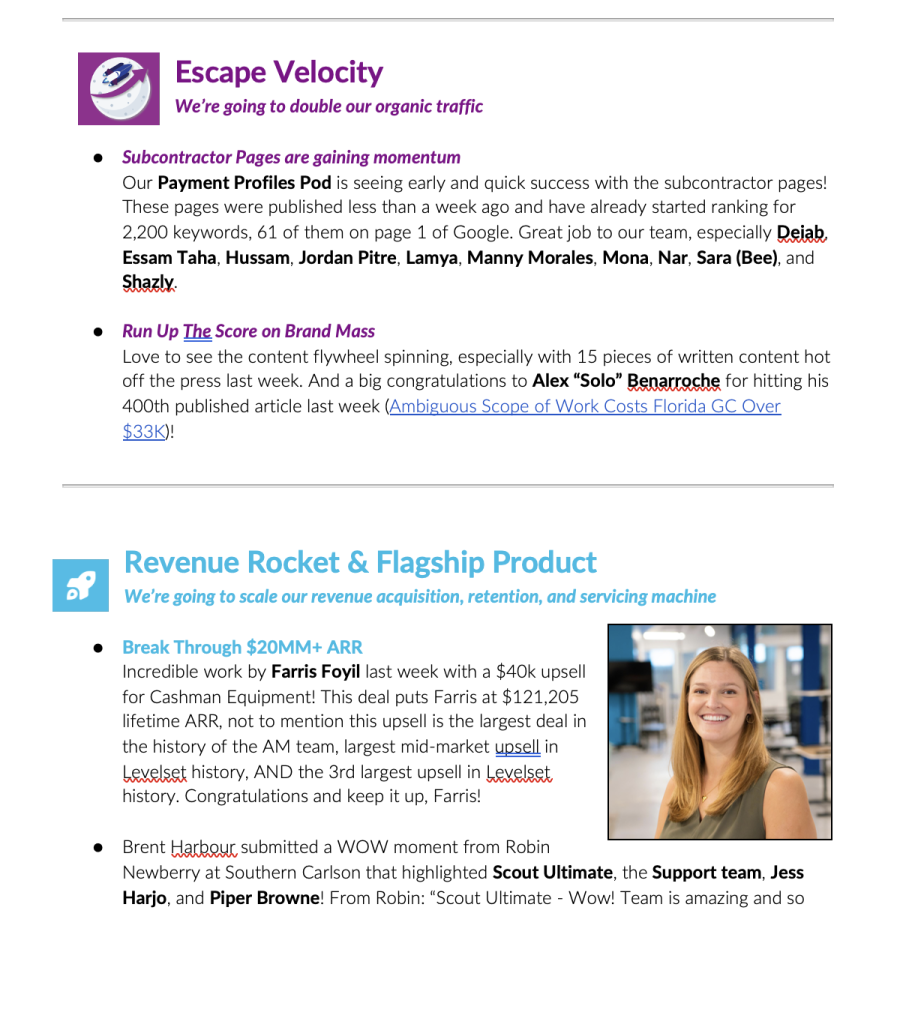
This 3rd Element is the absolute star of a CEO Recognition Program — Here, the CEO creates a routine recognition message. This is a message and format where the CEO will deliver recognition to the team(s). And while the specific implementation is unimportant (email, Slack, within all-hands meetings, etc.), the absolute most critical aspect is that it is routine. That is, it is extremely consistent.
First, in creating the message, think in frameworks and structures. Before writing-in any recognition, build out the message framework that you can use over and over again. This is typically something like the following, which is modeled off the message I used:
- Introduction / What I’m Excited About
- Why We Exist
- Strategic Goal 1 Title + 5-7 word subheadline describing
- Strategic Goal 2 Title + 5-7 word subheadline describing
- Strategic Goal 3 Title + 5-7 word subheadline describing
Any more than this is going to be too much.
Second, schedule this message in a routine. My primary routine was a Monday Morning message in Slack referred to as “Monday Morning Thoughts.”
4. Create Moments of Elevation for Broader, More Significant Recognition
The prior section is all about routine recognition. This section contemplates a less frequent recognition. It should happen with some consistent cadence (monthly, quarterly, annually, etc.), but it should feel special and not “routine.”
These broader recognition moments should be elevated to make them special, and should feel like a more material recognition. The same rules apply — keep them consistent, and keep them on message. Don’t let these recognition categories be random in any way.
And while the CEO is critical for the routine recognition element, the CEO can delegate some of these elevated moments to other leadership who are working more closely with the team members.
5. Make It Seamless To Cascade Downstream
When CEOs implement a Recognition Playbook, they’ll notice very quickly that others in the organization start to emulate it. This is fantastic news. A cascading recognition program is exactly what the CEO wants. This turns into a full leadership communication strategy, and an excellent, personal, concrete, and sticky one!
So, this final step is to make it easier and more seamless for this to cascade downstream through the ranks. You can do that by…recognition! Recognize those executives and leaders who are emulating the program, make it easy for them, and contribute to it for them.
The Levelset Recognition Playbook
Levelset was a fast-growing tech company that — at scale — had 425+ employees spread both remotely and across 3 separate offices. It was an absolute 5-star culture with all the Glassdoor and eNPS numbers to back it. Here’s a quick overview of our recognition program:
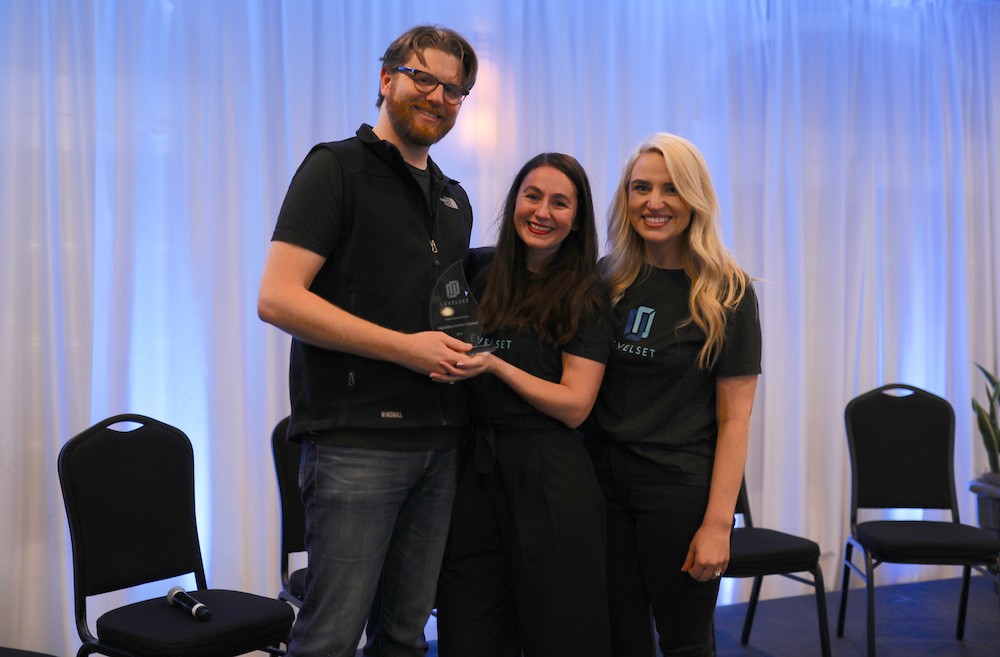
- CEO’s Routine Monday Morning Message: I ran the above CEO Recognition Playbook. We designed good spotting systems, and I shared a message every Monday Morning with the full team on Slack’s #general channel. These MMTs turned into a massively valuable tool for me to re-iterate the behaviors and work that was important so everyone knew and remembered it, and then to spotlight the great work in those categories.
- Monthly “Thumbs Up” For Each Value: We have 5 Core Values. Every month, senior leadership would select one person to get a “Thumbs Up” for that value. We created a slide for each value. The slide contained the team members’ name, a big photo, and a quote from the manager about why/how they embodied the value. The manager would present for that employee at the monthly all-hands, and thank them.
- Quarterly “Thumbs Up” For Each Value: All monthly “Thumbs Up” receivers would qualify for a “Quarterly Thumbs Up.” For this, we put all the names together and sent it around the entire company for a vote.
- Annual MVP Per Priority: At the annual meeting, we’d award a team member with a MVP award connected to each of the company’s annual priorities (5 or less of these). The winner would be decided by senior leadership as the person who had the most outsized impact on the company’s progress toward that priority. The manager would again present this to the team, and give trophies, take photos, etc.
- Shoutouts in Slack & Best-Of Emoji: We empowered the full team to give Shoutouts in Slack to other teammates, and Slack was full of peer-to-peer recognition. Teammates would “tag” values, goals, or mission with custom emojis, and would often tag with “best of” to make sure the CEO (me) saw it!
Turning Recognition Into a CEO’s Cultural Advantage
Recognition is not soft, secondary work. It is the CEO’s sharpest communication tool — a way to market culture with the same conviction as strategy.
The playbook is simple:
- Anchor recognition to mission, values, and goals;
- Be the company’s #1 spotter; and
- Use names to make culture concrete.
Do this consistently, and recognition will cascade through every level of the organization, binding employees, partners, investors, and advisors into a shared story. The sweetest words may be “well done,” but the smartest words for a CEO are the ones that build culture every time they’re spoken.