There’s a small moment that happens on every team, probably a dozen times a day. Someone thinks, “I should tell her that presentation was really good.” And then they don’t. They tell themselves she’s busy, it might come across as weird, they’ll catch her later. Later never comes.
I read this Forbes piece recently by Julie Kratz that put a name to why that happens, and it’s honestly quite sad. She interviewed Nick Epley, a behavioral scientist at the University of Chicago, and his research landed on something quietly devastating: we consistently believe people will respond less warmly to us reaching out than they actually do. He calls it social pessimism. We talk ourselves out of connection because we assume it will be awkward or unwelcome, when in reality the person on the other end almost always appreciates it more than we expect.
His second point is the one I want every leader to sit with. Epley says lasting culture change does not come from big, dramatic overhauls. It comes from micro-interactions repeated often. In his words, “happiness is really a function not of the intensity of experiences that you have, but rather the frequency of them.”
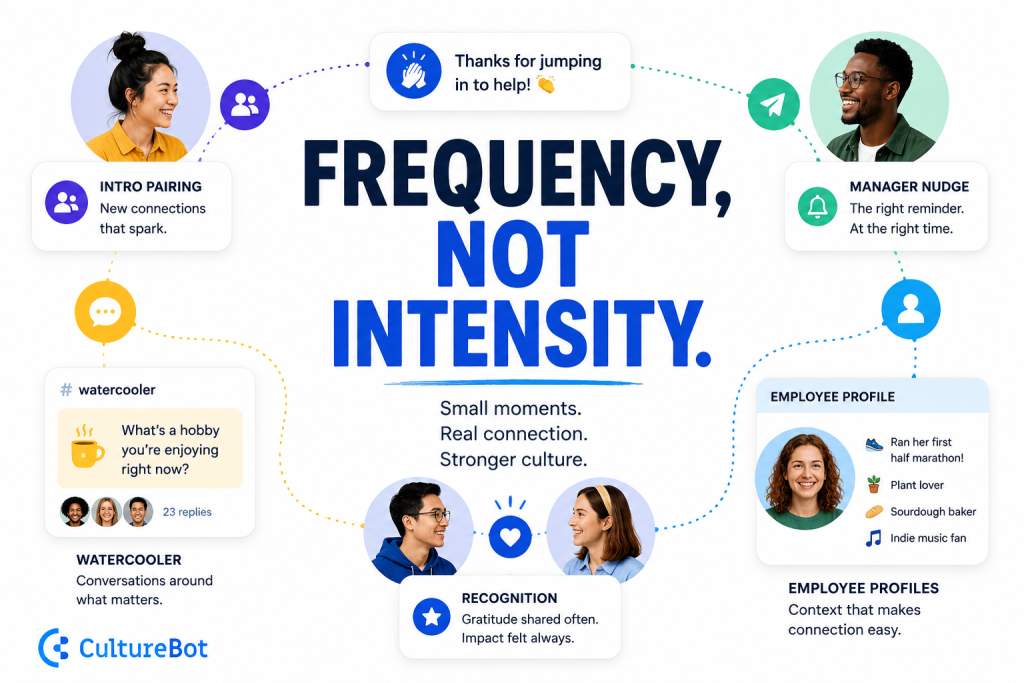
Frequency, not intensity. That single line is the truest thing I have read about culture all year, and it is the entire reason we built CultureBot.
People leaders can design the awkwardness away
Here is what I learned running People teams: you cannot lecture a team into connection. Telling everyone to “reach out more” does nothing, because the barrier was never willingness. The barrier is that first awkward inch. The uncertainty about whether it is welcome, whether it is the right time, whether it is your place.
The best thing a People leader can do to build employee connection is remove the friction from the small moments so people actually take them. When the awkward inch is handled for you, the gratitude, the welcome, the check-in all happen seamlessly. That is a design problem, and design problems are solvable.
What “frequency, not intensity” looks like for employee connection
This is the part I care about, because it is where good intentions usually fall apart. Everyone agrees small moments matter. Almost no one has a reliable way to make them happen every week, authentically, without depending on the few extroverts who were going to do it anyway.
That is exactly the gap CultureBot fills, right inside Slack or Teams where your team is already working:
Intro Pairings
Our intro pairings take the “I don’t really know that person” problem off the table. We pair people who would never cross paths otherwise and give them a reason to say hello, so the first inch is already taken.
Manager Nudges
Our manager nudges solve Epley’s social pessimism directly. Managers want to send a note of appreciation. They just forget, or talk themselves out of the timing. A simple, well-timed reminder turns a good intention into a message that actually gets sent.
Watercooler Conversation Starters
Our automated watercooler questions spark real conversation inside the groups people actually care about, whether that is the fitness crew, the cooking channel, or the new-parents group. Connection is easy when it starts from something you love talking about anyway.
Gratitude and Recognition
Our quick gratitude and recognition tool makes saying thank you a five-second action instead of a task you keep meaning to get to. Frequency only works when the tool is faster than the excuse.
Employee Profiles
And our employee profiles give people the context that makes reaching out feel natural. When you can see that someone ran their first half marathon last month or is learning to bake sourdough, the awkward inch disappears. You already have something to say.
None of these are grand gestures. Every one of them is a micro-interaction, made reliable. That is the whole point.
Employee connection is built in the small moments
I love that this research exists, because it confirms what a lot of us in People Ops have felt for years and struggled to prove: the small, frequent, human moments are not the soft stuff. They are the strategy. The companies that win on retention are not the ones throwing the best offsite. They are the ones where connection happens in the ordinary flow of the week, again and again, because someone made it easy.
We did not build CultureBot to manufacture culture. We built it to make the small rituals that actually make people happy easy enough that they happen every single week, without relying on anyone remembering to be thoughtful at exactly the right moment.
If Epley’s “frequency, not intensity” is the goal, this is the system that gets you there. See CultureBot In Action, and I will show you exactly how it works on a real team and you’ll leave with a clear picture of how these small moments could work for your team.